
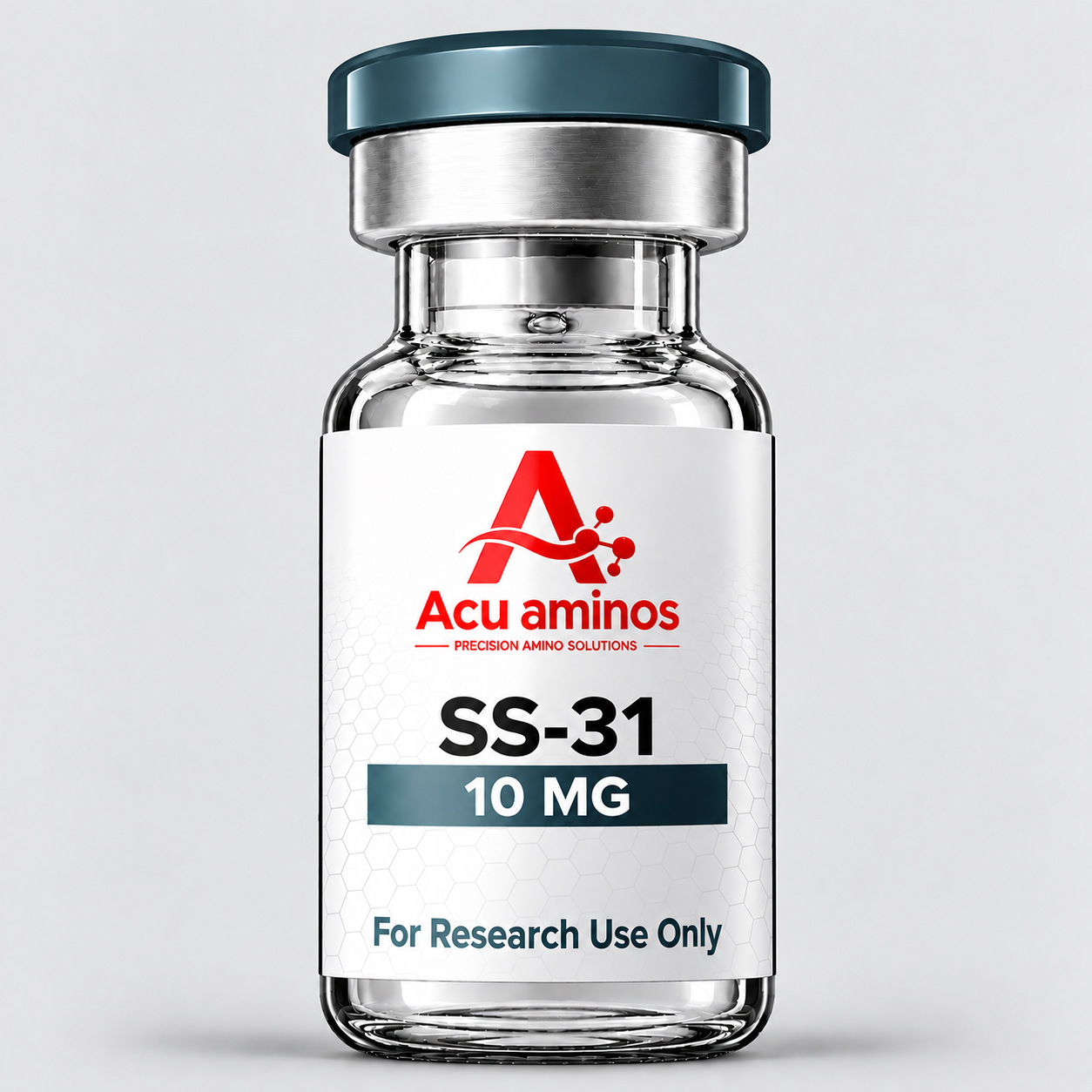
SS-31 10mg
$74.99
Szeto-Schiller peptide SS-31 (elamipretide), the mitochondria-targeted tetrapeptide D-Arg-Dmt-Lys-Phe-NH₂, 10 mg lyophilized. Studied for its interaction with cardiolipin in the inner mitochondrial membrane. ≥99% purity. Research use only.
Overview
SS-31, also known as elamipretide or MTP-131, is a synthetic aromatic-cationic tetrapeptide from the Szeto-Schiller series. Unlike most peptides it accumulates selectively in the inner mitochondrial membrane, where it binds the phospholipid cardiolipin. It is one of the most cited tool compounds in mitochondrial bioenergetics research.
Acu Aminos supplies SS-31 as a 10 mg lyophilized powder for laboratory research.
Chemistry & specifications
SS-31 alternates cationic and aromatic residues (D-Arg, 2′,6′-dimethyltyrosine, Lys, Phe) and is C-terminally amidated. The D-arginine and the non-natural dimethyltyrosine confer resistance to aminopeptidases, and the +3 net charge with alternating aromatic rings is what drives cell penetration and mitochondrial accumulation independent of membrane potential.
| Sequence | D-Arg-Dmt-Lys-Phe-NH2 (Dmt = 2′,6′-dimethyltyrosine) |
|---|---|
| Molecular formula | C32H49N9O5 |
| Molecular weight | 639.8 g/mol |
| CAS | 736992-21-5 |
| Net content | 10 mg per vial |
| Form | Lyophilized powder |
| Purity | ≥99% (HPLC) |
| Appearance | White lyophilized powder |
| Solubility | Water soluble |
| Storage | Lyophilized: −20 °C long term, 2–8 °C short term. Protect from light and moisture. |
Cellular structure & mechanism of action
Cardiolipin is a dimeric phospholipid concentrated in the inner mitochondrial membrane that anchors cytochrome c and organizes the respiratory supercomplexes. SS-31 binds cardiolipin electrostatically and through its aromatic rings, and in isolated-mitochondria and cell models this interaction has been reported to stabilize cristae structure, improve electron flow through the respiratory chain, reduce electron leak and reactive-oxygen-species generation, and limit cytochrome c peroxidase activity. These properties make it a standard positive control in studies of mitochondrial dysfunction, ischemia-reperfusion and oxidative stress in vitro and in animal models.
Research applications
- Isolated-mitochondria respiration (Seahorse, Oroboros) and ROS assays
- Cardiolipin-binding and cristae-morphology studies
- Ischemia-reperfusion and oxidative-stress cell models
- Mitochondrial-targeted peptide structure-activity research
Selected references
- Szeto HH. First-in-class cardiolipin-protective compound as a therapeutic agent to restore mitochondrial bioenergetics. Br J Pharmacol. 2014;171(8):2029–2050.
- Birk AV, Liu S, Soong Y, et al. The mitochondrial-targeted compound SS-31 re-energizes ischemic mitochondria by interacting with cardiolipin. J Am Soc Nephrol. 2013;24(8):1250–1261.
- Zhao K, Zhao GM, Wu D, et al. Cell-permeable peptide antioxidants targeted to inner mitochondrial membrane inhibit mitochondrial swelling, oxidative cell death, and reperfusion injury. J Biol Chem. 2004;279(33):34682–34690.
References are provided to help researchers locate primary literature. Acu Aminos makes no claims about the safety or efficacy of any compound in humans or animals.
What are research peptides?
Structure
Peptides are chains of amino acids joined by amide (peptide) bonds. Short chains of 2 to roughly 50 residues are called peptides; longer chains fold into proteins. Sequence, chain length and terminal modifications define how a peptide behaves.
Synthesis & purity
Research peptides are built by solid-phase peptide synthesis, cleaved from the resin, purified by reverse-phase HPLC and lyophilized to a stable powder. Purity is reported as the HPLC area percentage of the target peak; identity is confirmed by mass spectrometry.
Laboratory use
In the lab, peptides serve as receptor ligands, enzyme substrates, signaling probes and reference standards in cell-culture, biochemical and analytical studies. Our products are supplied exclusively for these in-vitro research applications.
Handling & storage
Lyophilized peptides should be kept sealed, protected from light and moisture, and stored refrigerated or frozen for long-term stability. Allow vials to reach room temperature before opening to prevent condensation.
All information on this page is provided for educational and research reference only and does not constitute medical advice or a recommendation for use in humans or animals.
Related research peptides
-
99% Purity
 Growth Hormone Secretagogues
CJC-1295 / Ipamorelin 10mg
10 mg · CJC-1295 (no DAC) 5 mg + Ipamorelin 5 mg · ≥99% purity$84.99In stock -
99% Purity
 Mitochondrial & Longevity
MOTS-c 10mg
10 mg · Mitochondrial-derived 16-aa peptide · ≥99% purity$99.99In stock -
99% Purity
 Mitochondrial & Longevity
NAD+ 1000mg
1000 mg · Nicotinamide adenine dinucleotide · ≥99% purity$94.99In stock -
99% Purity
 Tissue & Repair Signaling
Thymosin Beta-4 (TB-500) 10mg
10 mg · Actin-sequestering 43-aa peptide · ≥99% purity$64.99In stock