
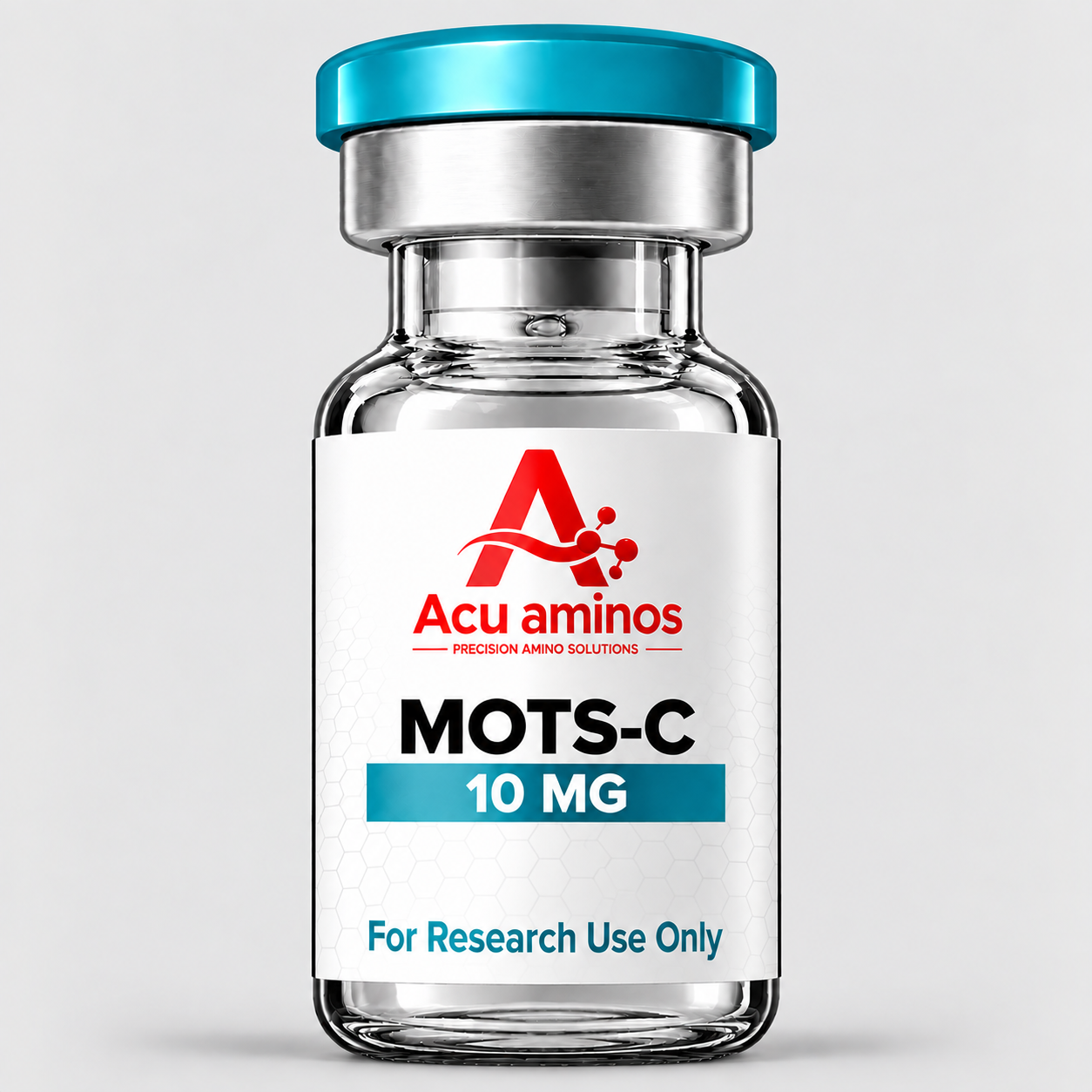
MOTS-c 10mg
$99.99
Mitochondrial open reading frame of the 12S rRNA type-c (MOTS-c), a 16-residue peptide encoded in mitochondrial DNA, 10 mg lyophilized. Studied in AMPK, folate-methionine cycle and metabolic-signaling research. ≥99% purity. Research use only.
Overview
MOTS-c is a 16-amino-acid peptide encoded by a short open reading frame within the mitochondrial 12S ribosomal RNA gene, first described in 2015. It belongs to the family of mitochondrial-derived peptides (with humanin and the SHLPs) and is notable for translocating to the nucleus under metabolic stress, where it has been reported to regulate nuclear gene expression.
Acu Aminos supplies synthetic MOTS-c as a 10 mg lyophilized powder for laboratory research.
Chemistry & specifications
MOTS-c is a linear, unmodified 16-residue peptide (MRWQEMGYIFYPRKLR) with a net positive charge and two methionine residues that are susceptible to oxidation. It has no disulfide bonds and is readily water soluble.
| Sequence | Met-Arg-Trp-Gln-Glu-Met-Gly-Tyr-Ile-Phe-Tyr-Pro-Arg-Lys-Leu-Arg |
|---|---|
| Molecular formula | C101H152N28O22S2 |
| Molecular weight | 2174.6 g/mol |
| CAS | 1627580-64-6 |
| Net content | 10 mg per vial |
| Form | Lyophilized powder |
| Purity | ≥99% (HPLC) |
| Appearance | White lyophilized powder |
| Solubility | Water soluble |
| Storage | Lyophilized: −20 °C long term, 2–8 °C short term. Protect from light and moisture. Contains methionine; minimize oxidation. |
Cellular structure & mechanism of action
In cell and animal models, MOTS-c has been reported to inhibit the folate cycle and de novo purine synthesis, leading to accumulation of AICAR and activation of AMP-activated protein kinase (AMPK), a master regulator of cellular energy balance. Under glucose restriction or oxidative stress, MOTS-c translocates to the nucleus and associates with stress-responsive transcription factors including NRF2, altering the expression of antioxidant and metabolic genes. Its levels have been reported to change with exercise and age in the literature, making it a frequently used probe in mitochondrial-nuclear communication research.
Research applications
- AMPK activation and folate/one-carbon metabolism assays
- Mitochondrial-nuclear retrograde signaling studies
- Skeletal-muscle and adipocyte metabolic cell models
- Mitochondrial-derived peptide comparative research (humanin, SHLPs)
Selected references
- Lee C, Zeng J, Drew BG, et al. The mitochondrial-derived peptide MOTS-c promotes metabolic homeostasis and reduces obesity and insulin resistance. Cell Metab. 2015;21(3):443–454.
- Kim KH, Son JM, Benayoun BA, Lee C. The mitochondrial-encoded peptide MOTS-c translocates to the nucleus to regulate nuclear gene expression in response to metabolic stress. Cell Metab. 2018;28(3):516–524.
- Reynolds JC, Lai RW, Woodhead JST, et al. MOTS-c is an exercise-induced mitochondrial-encoded regulator of age-dependent physical decline and muscle homeostasis. Nat Commun. 2021;12:470.
References are provided to help researchers locate primary literature. Acu Aminos makes no claims about the safety or efficacy of any compound in humans or animals.
What are research peptides?
Structure
Peptides are chains of amino acids joined by amide (peptide) bonds. Short chains of 2 to roughly 50 residues are called peptides; longer chains fold into proteins. Sequence, chain length and terminal modifications define how a peptide behaves.
Synthesis & purity
Research peptides are built by solid-phase peptide synthesis, cleaved from the resin, purified by reverse-phase HPLC and lyophilized to a stable powder. Purity is reported as the HPLC area percentage of the target peak; identity is confirmed by mass spectrometry.
Laboratory use
In the lab, peptides serve as receptor ligands, enzyme substrates, signaling probes and reference standards in cell-culture, biochemical and analytical studies. Our products are supplied exclusively for these in-vitro research applications.
Handling & storage
Lyophilized peptides should be kept sealed, protected from light and moisture, and stored refrigerated or frozen for long-term stability. Allow vials to reach room temperature before opening to prevent condensation.
All information on this page is provided for educational and research reference only and does not constitute medical advice or a recommendation for use in humans or animals.
Related research peptides
-
99% Purity
 Growth Hormone Secretagogues
Ipamorelin 10mg
10 mg · Pentapeptide GHS-R agonist · ≥99% purity$54.99In stock -
99% Purity
 Tissue & Repair Signaling
GLOW 70mg
70 mg · GHK-Cu 50 / BPC-157 10 / TB-500 10 blend · ≥99% purity$119.99In stock -
99% Purity
 Mitochondrial & Longevity
NAD+ 1000mg
1000 mg · Nicotinamide adenine dinucleotide · ≥99% purity$94.99In stock -
99% Purity
 Mitochondrial & Longevity
SS-31 10mg
10 mg · Mitochondria-targeted tetrapeptide · ≥99% purity$74.99In stock