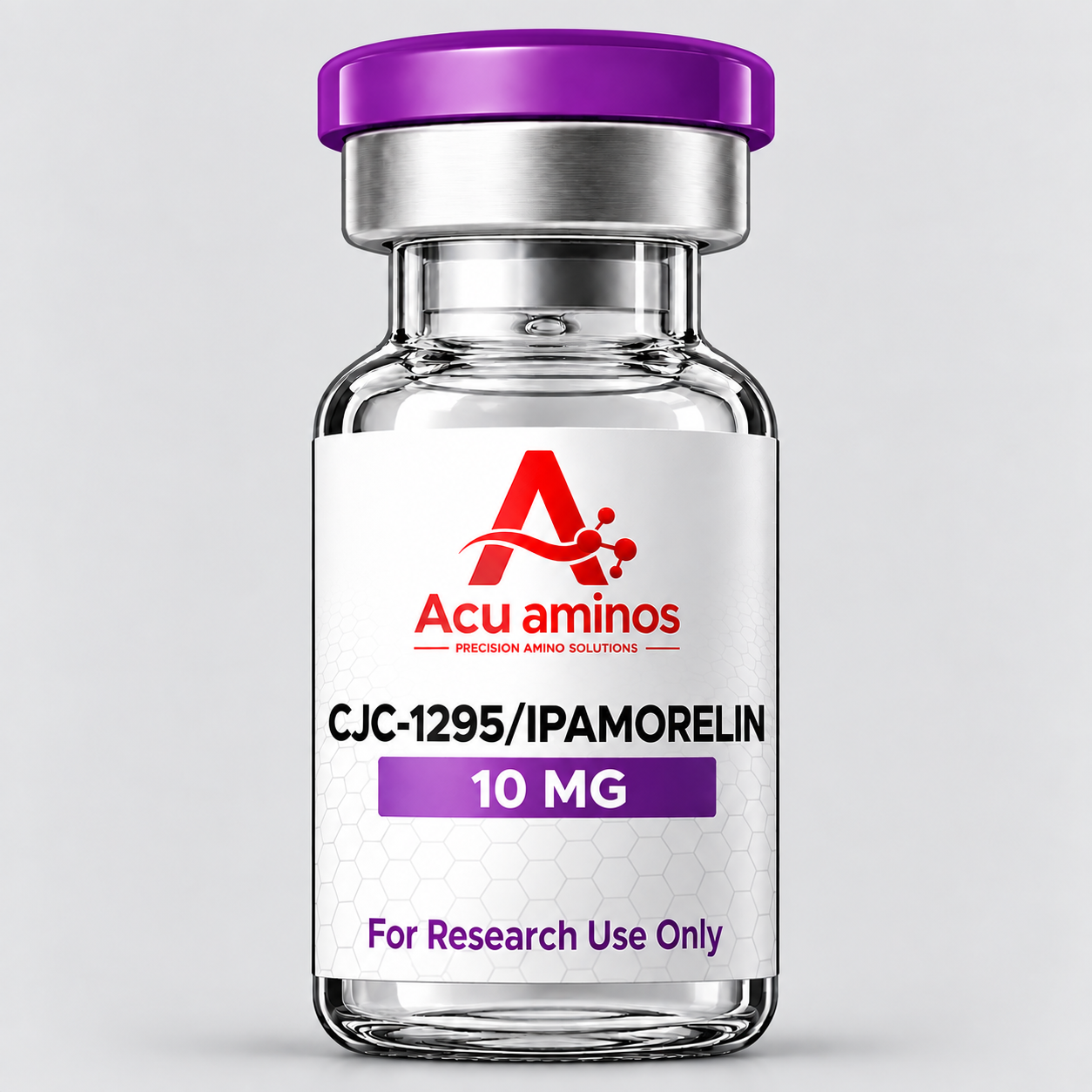
CJC-1295 / Ipamorelin 10mg
$84.99
Co-lyophilized blend of CJC-1295 without DAC (Modified GRF 1-29) 5 mg and Ipamorelin 5 mg. A GHRH-receptor analog and a selective GHS-R1a agonist in one vial for somatotroph-signaling and receptor-pharmacology research. ≥99% purity per component. Research use only.
Overview
This blend pairs two growth-hormone secretagogues that act on different receptors of the same pituitary cell. CJC-1295 without DAC, also called Modified GRF (1-29), is a tetra-substituted analog of the first 29 residues of growth-hormone-releasing hormone (GHRH). Ipamorelin is a selective pentapeptide agonist of the ghrelin receptor (GHS-R1a). The two pathways are frequently studied together because they converge on somatotroph cAMP and calcium signaling.
Acu Aminos supplies the blend as a 10 mg lyophilized powder (5 mg + 5 mg). Ipamorelin is also available on its own.
Chemistry & specifications
CJC-1295 (no DAC) is GHRH(1-29)-NH₂ with four substitutions (D-Ala², Gln⁸, Ala¹⁵, Leu²⁷) that protect it from DPP-4 cleavage and oxidation while preserving GHRH-receptor affinity. It contains no Drug Affinity Complex (the maleimidopropionic-acid linker found in the albumin-binding “with DAC” version). Ipamorelin (Aib-His-D-2-Nal-D-Phe-Lys-NH₂) contains non-natural residues that resist proteolysis and an amidated C-terminus. Both are water soluble and co-lyophilized without excipients.
| Components | CJC-1295 no DAC (Mod GRF 1-29) 5 mg + Ipamorelin 5 mg |
|---|---|
| CJC-1295 no DAC formula / MW | C152H252N44O42, 3367.9 g/mol, CAS 863288-34-0 |
| Ipamorelin formula / MW | C38H49N9O5, 711.9 g/mol, CAS 170851-70-4 |
| Net content | 10 mg per vial |
| Form | Lyophilized powder |
| Purity | ≥99% (HPLC) per component |
| Appearance | White lyophilized powder |
| Solubility | Water soluble |
| Storage | Lyophilized: −20 °C long term, 2–8 °C short term. Protect from light and moisture. |
Cellular structure & mechanism of action
The GHRH receptor is a class B GPCR coupled to Gαs; agonist binding raises cAMP and activates PKA in somatotrophs. GHS-R1a is a class A GPCR coupled to Gαq/11; agonist binding raises intracellular calcium through the phospholipase C pathway. In pituitary cell models, co-stimulation of both receptors produces a greater secretory response than either pathway alone, and ghrelin-receptor agonists are also reported to suppress somatostatin tone. This dual-pathway model is why the combination is used in vitro to study synergy between cAMP- and calcium-driven exocytosis.
Research applications
- GHRH-receptor and GHS-R1a co-stimulation assays in pituitary cell models
- cAMP / calcium signaling synergy studies
- Peptide stability and DPP-4 resistance research
- Secretagogue comparative pharmacology
Selected references
- Teichman SL, Neale A, Lawrence B, et al. Prolonged stimulation of growth hormone (GH) and insulin-like growth factor I secretion by CJC-1295, a long-acting analog of GH-releasing hormone, in healthy adults. J Clin Endocrinol Metab. 2006;91(3):799–805.
- Ionescu M, Frohman LA. Pulsatile secretion of growth hormone (GH) persists during continuous stimulation by CJC-1295, a long-acting GH-releasing hormone analog. J Clin Endocrinol Metab. 2006;91(12):4792–4797.
- Raun K, Hansen BS, Johansen NL, et al. Ipamorelin, the first selective growth hormone secretagogue. Eur J Endocrinol. 1998;139(5):552–561.
References are provided to help researchers locate primary literature. Acu Aminos makes no claims about the safety or efficacy of any compound in humans or animals.
What are research peptides?
Structure
Peptides are chains of amino acids joined by amide (peptide) bonds. Short chains of 2 to roughly 50 residues are called peptides; longer chains fold into proteins. Sequence, chain length and terminal modifications define how a peptide behaves.
Synthesis & purity
Research peptides are built by solid-phase peptide synthesis, cleaved from the resin, purified by reverse-phase HPLC and lyophilized to a stable powder. Purity is reported as the HPLC area percentage of the target peak; identity is confirmed by mass spectrometry.
Laboratory use
In the lab, peptides serve as receptor ligands, enzyme substrates, signaling probes and reference standards in cell-culture, biochemical and analytical studies. Our products are supplied exclusively for these in-vitro research applications.
Handling & storage
Lyophilized peptides should be kept sealed, protected from light and moisture, and stored refrigerated or frozen for long-term stability. Allow vials to reach room temperature before opening to prevent condensation.
All information on this page is provided for educational and research reference only and does not constitute medical advice or a recommendation for use in humans or animals.
Related research peptides
-
99% Purity
 Immune & Neuro Peptides
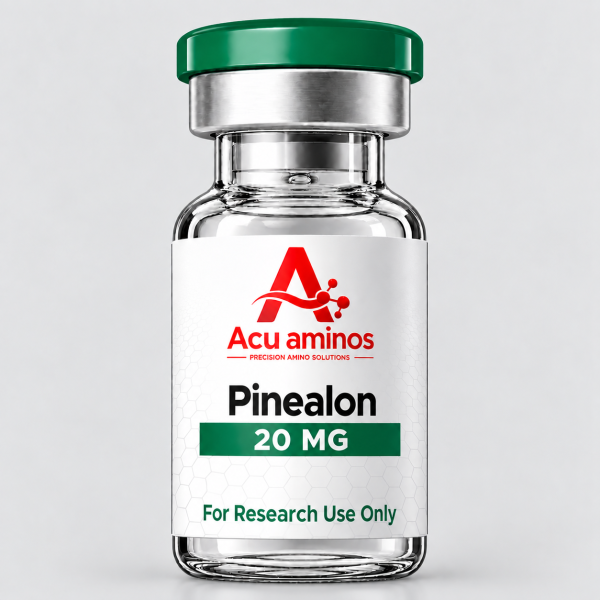
Pinealon 20mg
20 mg · Glu-Asp-Arg bioregulator tripeptide · ≥99% purity$59.99In stock -
99% Purity
 Immune & Neuro Peptides
Kisspeptin-10 10mg
10 mg · KISS1R ligand decapeptide · ≥99% purity$49.99In stock -
99% Purity
 Growth Hormone Secretagogues
Ipamorelin 10mg
10 mg · Pentapeptide GHS-R agonist · ≥99% purity$54.99In stock