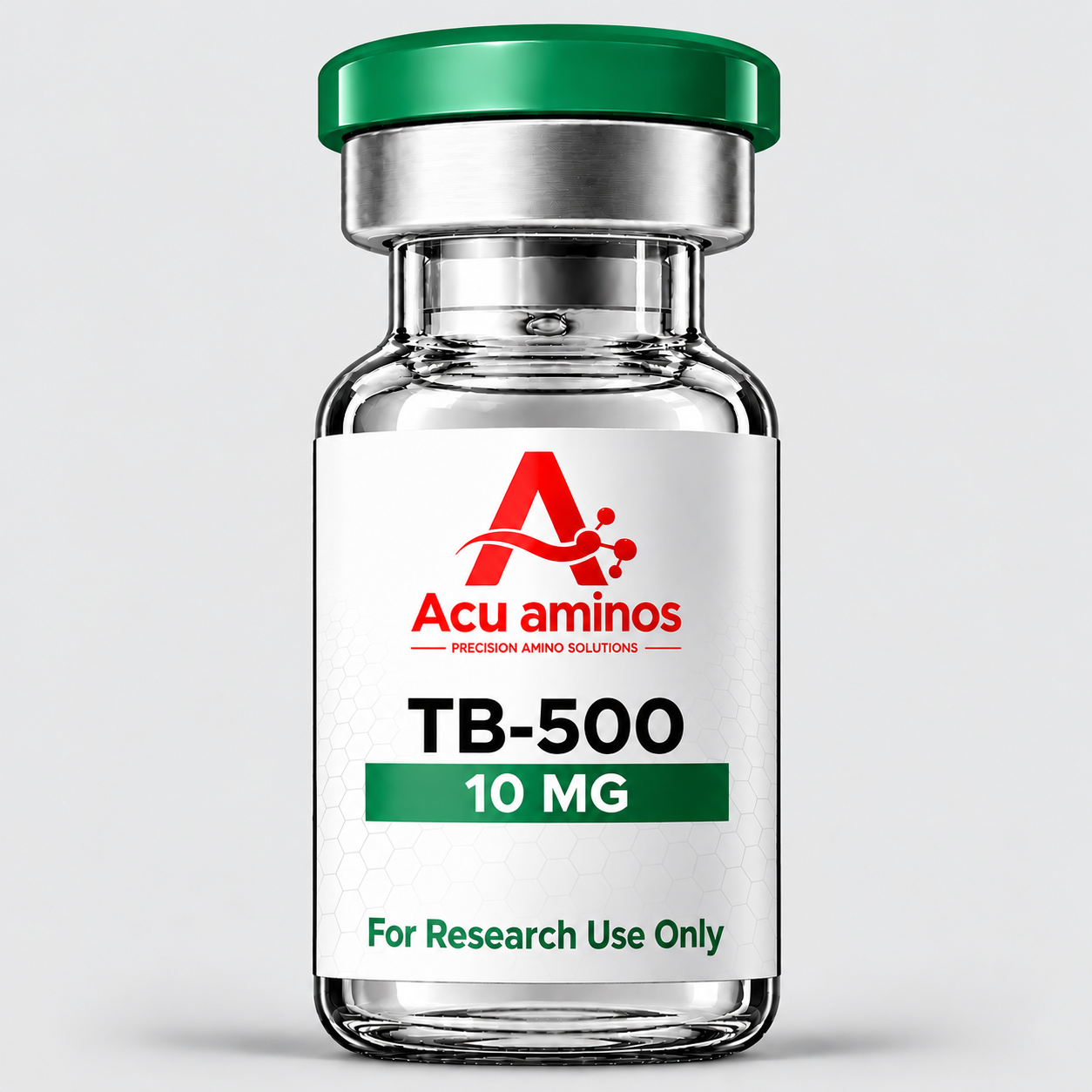
Thymosin Beta-4 (TB-500) 10mg
$64.99
Synthetic Thymosin β4 (commonly designated TB-500), 10 mg lyophilized. A 43-residue actin-sequestering peptide studied in cell-migration, angiogenesis and tissue-model research. ≥99% purity, COA for every lot. Research use only.
Overview
Thymosin β4 (Tβ4) is a 43-amino-acid peptide and the most abundant member of the β-thymosin family, present at high concentration in platelets, leukocytes and most mammalian cell types. Its primary intracellular role is sequestration of monomeric G-actin, which makes it a central regulator of the actin cytoskeleton. The designation “TB-500” is widely used in research-supply nomenclature for synthetic Tβ4 and its active fragment; the material supplied is described on the lot COA.
Acu Aminos supplies TB-500 as a 10 mg lyophilized powder for laboratory cell-biology research.
Chemistry & specifications
Tβ4 is a highly conserved, N-terminally acetylated, intrinsically disordered peptide. Its central actin-binding motif, LKKTETQ (residues 17–23), is required for G-actin sequestration and is the region most frequently synthesized as a stand-alone fragment in structure-function work. The full-length peptide adopts helical structure at the N- and C-termini upon binding actin.
| Sequence (Tβ4) | Ac-SDKPDMAEIEKFDKSKLKKTETQEKNPLPSKETIEQEKQAGES |
|---|---|
| Molecular formula (Tβ4) | C212H350N56O78S |
| Molecular weight | ≈4963 g/mol (full-length Tβ4) |
| Active motif | LKKTETQ (residues 17–23) |
| CAS | 77591-33-4 (Tβ4) |
| Net content | 10 mg per vial |
| Form | Lyophilized powder |
| Purity | ≥99% (HPLC) |
| Appearance | White lyophilized powder |
| Storage | Lyophilized: −20 °C long term, 2–8 °C short term. Protect from light and moisture. Contains methionine; minimize oxidation. |
Cellular structure & mechanism of action
By binding G-actin in a 1:1 complex, Tβ4 maintains the pool of unpolymerized actin that cells draw on for rapid cytoskeletal remodeling. In cell-culture and animal models, Tβ4 has been reported to promote endothelial and keratinocyte migration, stimulate angiogenesis, down-regulate inflammatory cytokines and reduce apoptosis. A well-known mechanistic study demonstrated that Tβ4 forms a complex with PINCH and integrin-linked kinase (ILK), activating Akt survival signaling in cardiac cells. Extracellular Tβ4 also serves as the precursor of the tetrapeptide Ac-SDKP, which has its own biological activity in the literature.
Research applications
- Actin-polymerization and G-actin sequestration assays
- Endothelial, keratinocyte and fibroblast migration (scratch) assays
- Angiogenesis and tube-formation models
- ILK/Akt signaling and cardiomyocyte survival research
- Corneal epithelial and dermal wound models
Selected references
- Safer D, Elzinga M, Nachmias VT. Thymosin β4 and Fx, an actin-sequestering peptide, are indistinguishable. J Biol Chem. 1991;266:4029–4032.
- Bock-Marquette I, Saxena A, White MD, DiMaio JM, Srivastava D. Thymosin β4 activates integrin-linked kinase and promotes cardiac cell migration, survival and cardiac repair. Nature. 2004;432:466–472.
- Goldstein AL, Hannappel E, Kleinman HK. Thymosin β4: actin-sequestering protein moonlights to repair injured tissues. Trends Mol Med. 2005;11(9):421–429.
References are provided to help researchers locate primary literature. Acu Aminos makes no claims about the safety or efficacy of any compound in humans or animals.
What are research peptides?
Structure
Peptides are chains of amino acids joined by amide (peptide) bonds. Short chains of 2 to roughly 50 residues are called peptides; longer chains fold into proteins. Sequence, chain length and terminal modifications define how a peptide behaves.
Synthesis & purity
Research peptides are built by solid-phase peptide synthesis, cleaved from the resin, purified by reverse-phase HPLC and lyophilized to a stable powder. Purity is reported as the HPLC area percentage of the target peak; identity is confirmed by mass spectrometry.
Laboratory use
In the lab, peptides serve as receptor ligands, enzyme substrates, signaling probes and reference standards in cell-culture, biochemical and analytical studies. Our products are supplied exclusively for these in-vitro research applications.
Handling & storage
Lyophilized peptides should be kept sealed, protected from light and moisture, and stored refrigerated or frozen for long-term stability. Allow vials to reach room temperature before opening to prevent condensation.
All information on this page is provided for educational and research reference only and does not constitute medical advice or a recommendation for use in humans or animals.
Related research peptides
-
99% Purity
 Tissue & Repair Signaling
BPC-157
5 mg or 10 mg · Gastric pentadecapeptide · ≥99% purityFrom $52.99In stockChoose size This product has multiple variants. The options may be chosen on the product page -
99% Purity
 Tissue & Repair Signaling
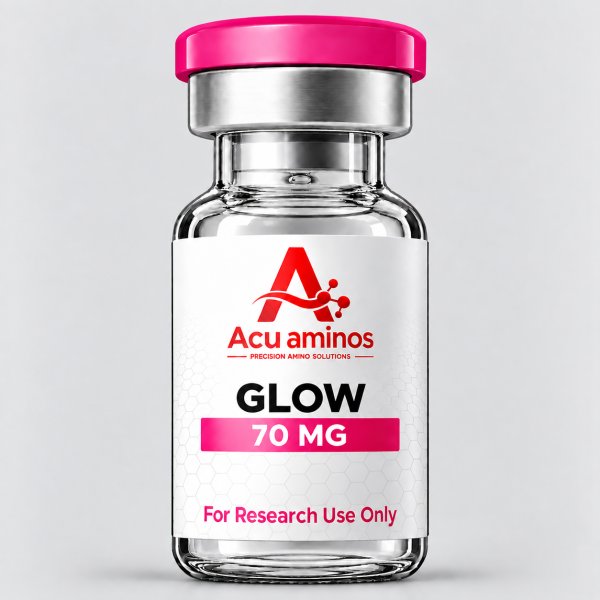
GLOW 70mg
70 mg · GHK-Cu 50 / BPC-157 10 / TB-500 10 blend · ≥99% purity$119.99In stock