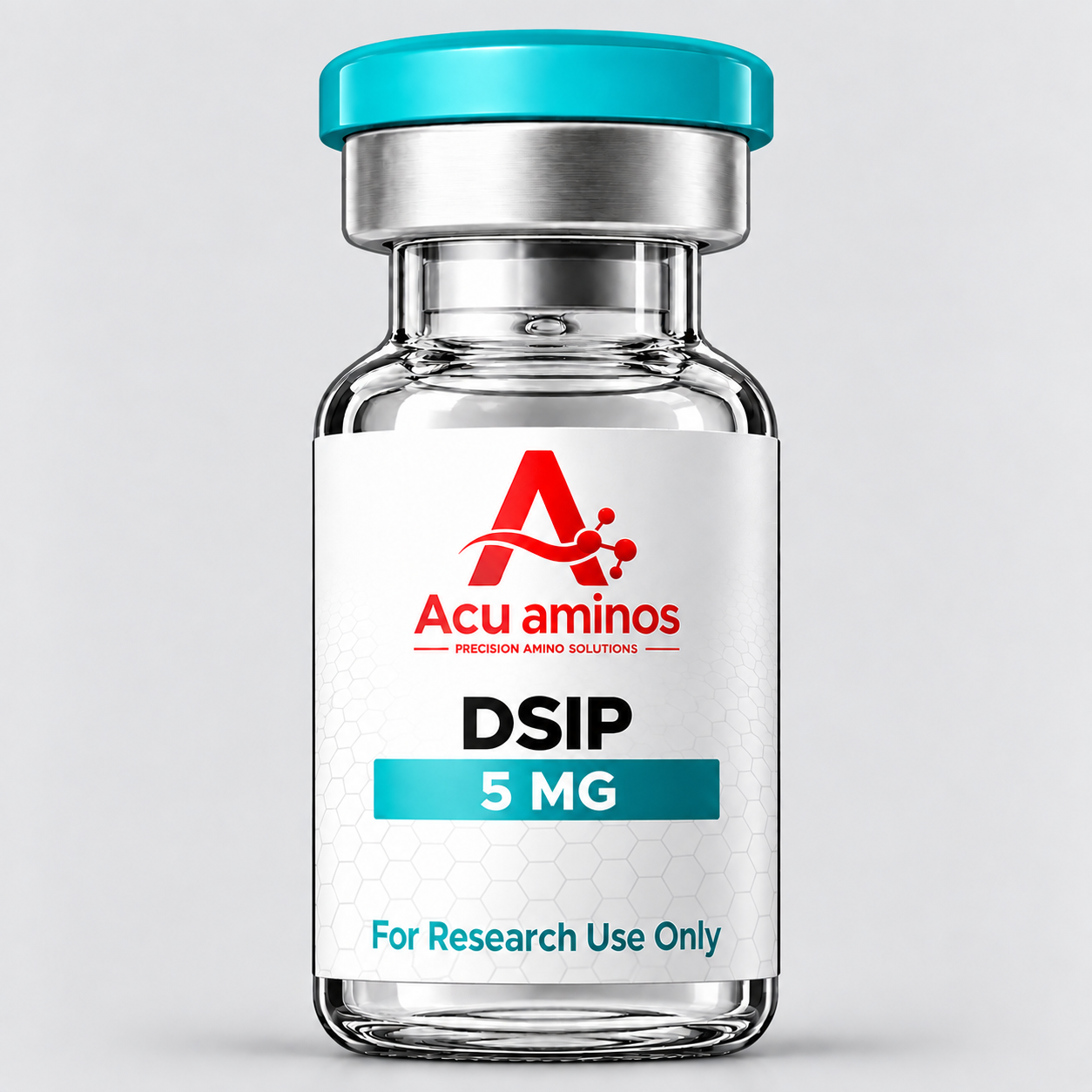
DSIP 5mg
$44.99
Delta sleep-inducing peptide, the nonapeptide Trp-Ala-Gly-Gly-Asp-Ala-Ser-Gly-Glu first isolated from rabbit cerebral venous blood, 5 mg lyophilized. Used in neuropeptide, EEG and neuroendocrine research. ≥99% purity. Research use only.
Overview
DSIP (delta sleep-inducing peptide) is a nine-residue neuropeptide isolated in 1977 from the cerebral venous blood of rabbits during electrically induced sleep. Its name comes from the delta-wave EEG activity reported in the original experiments. Nearly fifty years later its receptor and precise physiological role remain unresolved, which is why it continues to be a subject of neuropeptide research.
Acu Aminos supplies DSIP as a 5 mg lyophilized powder for laboratory research.
Chemistry & specifications
DSIP is a small, acidic, unmodified nonapeptide with a free N-terminal tryptophan and free C-terminal carboxylate. Its high glycine content gives it a flexible, largely unstructured conformation in solution. It is rapidly degraded by peptidases, and phosphorylated and D-amino-acid analogs have been synthesized in the literature to study stability.
| Sequence | Trp-Ala-Gly-Gly-Asp-Ala-Ser-Gly-Glu |
|---|---|
| Molecular formula | C35H48N10O15 |
| Molecular weight | 848.8 g/mol |
| CAS | 62568-57-4 |
| Net content | 5 mg per vial |
| Form | Lyophilized powder |
| Purity | ≥99% (HPLC) |
| Appearance | White lyophilized powder |
| Solubility | Water soluble |
| Storage | Lyophilized: −20 °C long term, 2–8 °C short term. Protect from light and moisture. |
Cellular structure & mechanism of action
No dedicated DSIP receptor has been identified. Published work proposes interactions with GABAergic and glutamatergic transmission, modulation of the hypothalamic-pituitary-adrenal axis (reduced ACTH and corticotropin-releasing-hormone release in some models), and effects on MAO-A activity and oxidative stress in neuronal tissue. Its EEG effects in animal models have been inconsistent across laboratories, and the compound is often cited as an example of a bioactive peptide whose mechanism is still open. DSIP-like immunoreactivity has been detected in the hypothalamus, pituitary and gut, suggesting a peptide precursor that has not been fully characterized.
Research applications
- Neuropeptide receptor-identification and binding studies
- EEG and sleep-architecture research in animal models
- HPA-axis and stress-hormone signaling assays
- Peptide stability and analog structure-activity research
Selected references
- Schoenenberger GA, Monnier M. Characterization of a delta-electroencephalogram (-sleep)-inducing peptide. Proc Natl Acad Sci USA. 1977;74(3):1282–1286.
- Kovalzon VM, Strekalova TV. Delta sleep-inducing peptide (DSIP): a still unresolved riddle. J Neurochem. 2006;97(2):303–309.
- Graf MV, Kastin AJ. Delta-sleep-inducing peptide (DSIP): an update. Peptides. 1986;7(6):1165–1187.
References are provided to help researchers locate primary literature. Acu Aminos makes no claims about the safety or efficacy of any compound in humans or animals.
What are research peptides?
Structure
Peptides are chains of amino acids joined by amide (peptide) bonds. Short chains of 2 to roughly 50 residues are called peptides; longer chains fold into proteins. Sequence, chain length and terminal modifications define how a peptide behaves.
Synthesis & purity
Research peptides are built by solid-phase peptide synthesis, cleaved from the resin, purified by reverse-phase HPLC and lyophilized to a stable powder. Purity is reported as the HPLC area percentage of the target peak; identity is confirmed by mass spectrometry.
Laboratory use
In the lab, peptides serve as receptor ligands, enzyme substrates, signaling probes and reference standards in cell-culture, biochemical and analytical studies. Our products are supplied exclusively for these in-vitro research applications.
Handling & storage
Lyophilized peptides should be kept sealed, protected from light and moisture, and stored refrigerated or frozen for long-term stability. Allow vials to reach room temperature before opening to prevent condensation.
All information on this page is provided for educational and research reference only and does not constitute medical advice or a recommendation for use in humans or animals.
Related research peptides
-
99% Purity
 Immune & Neuro Peptides
Pinealon 20mg
20 mg · Glu-Asp-Arg bioregulator tripeptide · ≥99% purity$59.99In stock -
99% Purity
 Immune & Neuro Peptides
Kisspeptin-10 10mg
10 mg · KISS1R ligand decapeptide · ≥99% purity$49.99In stock -
99% Purity
 Immune & Neuro Peptides
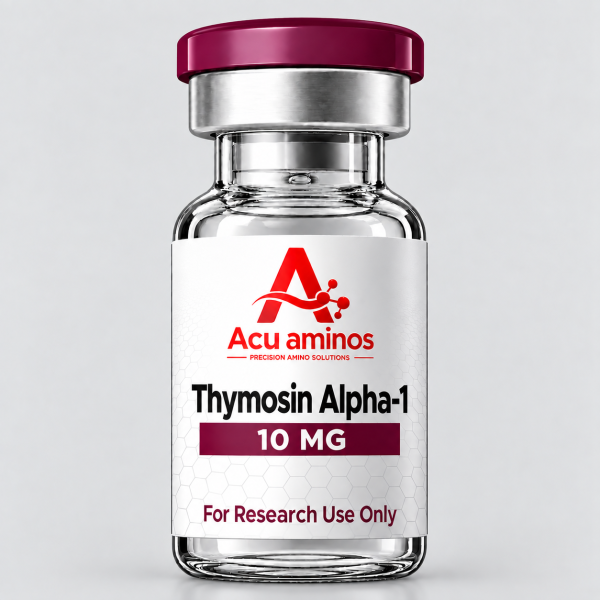
Thymosin Alpha-1 10mg
10 mg · 28-aa acetylated thymic peptide · ≥99% purity$99.99In stock -
99% Purity
 Immune & Neuro Peptides
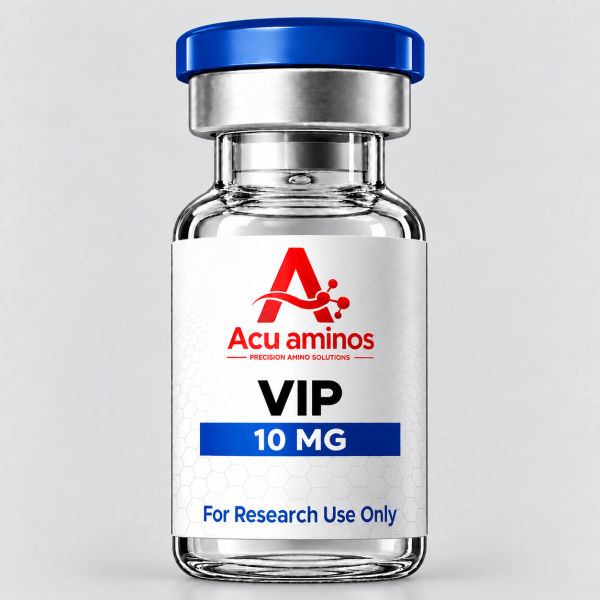
VIP 10mg
10 mg · Vasoactive intestinal peptide, 28 aa · ≥99% purity$74.99In stock