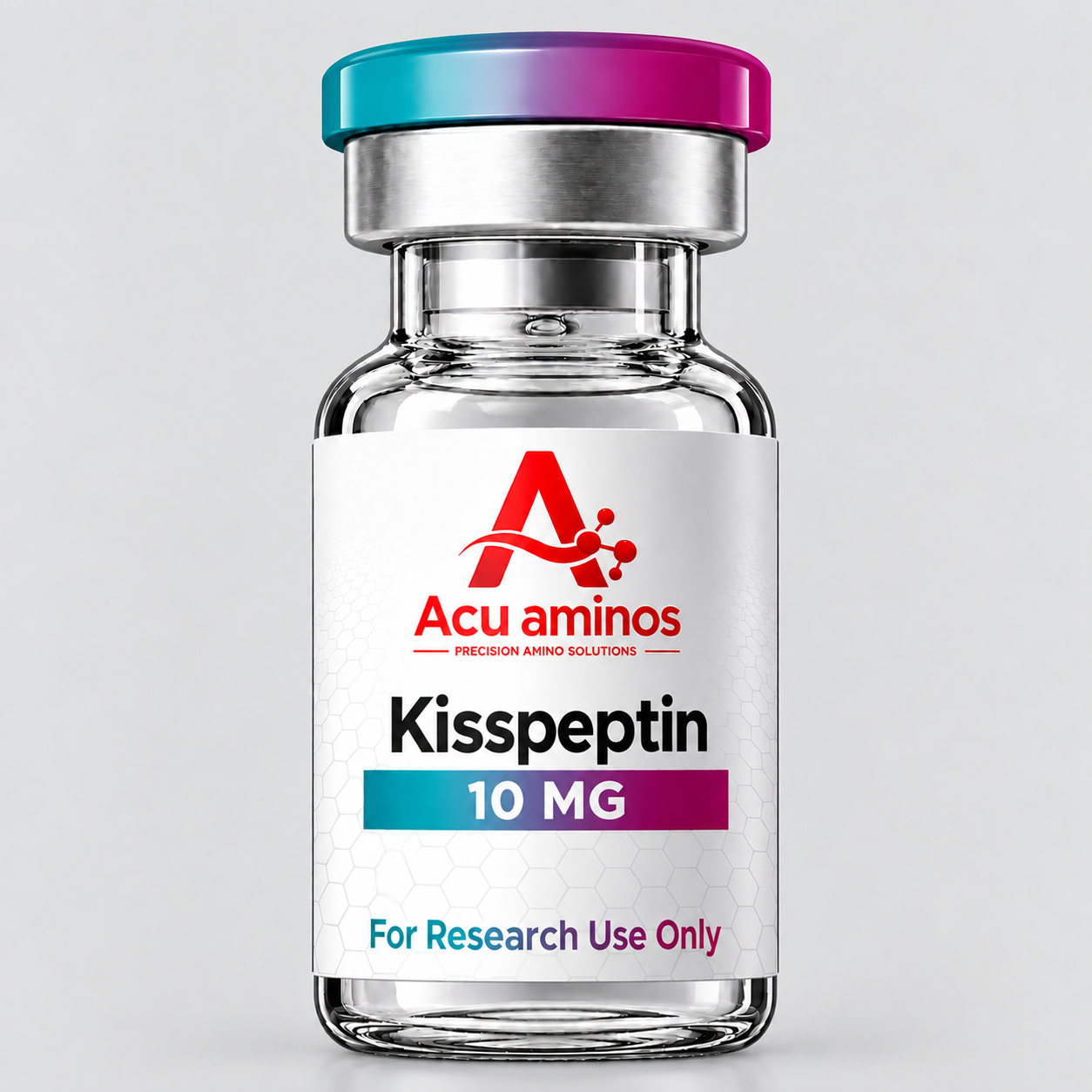
Kisspeptin-10 10mg
$49.99
C-terminal decapeptide fragment of the KISS1 gene product (YNWNSFGLRF-NH₂), 10 mg lyophilized. The minimal active ligand of the kisspeptin receptor KISS1R (GPR54), used in neuroendocrine and GPCR research. ≥99% purity. Research use only.
Overview
Kisspeptins are a family of peptides encoded by the KISS1 gene, originally identified as metastasis-suppressor products and later recognized as the endogenous ligands of the G-protein-coupled receptor GPR54 (KISS1R). Kisspeptin-10 is the C-terminal decapeptide that retains full receptor activity and is the most widely used form in laboratory research.
Acu Aminos supplies Kisspeptin-10 as a 10 mg lyophilized powder for receptor-pharmacology and neuroendocrine-signaling studies.
Chemistry & specifications
Kisspeptin-10 is a C-terminally amidated decapeptide belonging to the RF-amide peptide family, sharing the Arg-Phe-NH₂ motif with related neuropeptides. The amidated C-terminus and the aromatic Phe residues are required for high-affinity binding to KISS1R.
| Sequence | Tyr-Asn-Trp-Asn-Ser-Phe-Gly-Leu-Arg-Phe-NH2 |
|---|---|
| Molecular formula | C63H83N17O14 |
| Molecular weight | 1302.4 g/mol |
| CAS | 374675-21-5 |
| Net content | 10 mg per vial |
| Form | Lyophilized powder |
| Purity | ≥99% (HPLC) |
| Appearance | White lyophilized powder |
| Solubility | Water soluble |
| Storage | Lyophilized: −20 °C long term, 2–8 °C short term. Protect from light and moisture. |
Cellular structure & mechanism of action
KISS1R couples predominantly to Gαq/11. Ligand binding activates phospholipase Cβ, generating IP3 and diacylglycerol, releasing intracellular calcium and activating protein kinase C and the ERK1/2 MAPK cascade. In hypothalamic neuron models, kisspeptin signaling is a principal upstream regulator of GnRH neuron activity, and loss-of-function mutations in GPR54 were the discovery that linked this receptor to reproductive endocrinology. In cancer-cell models, KISS1/KISS1R signaling has been studied for its effects on cell motility and invasion.
Research applications
- KISS1R/GPR54 binding, calcium-mobilization and ERK-phosphorylation assays
- GnRH neuron and hypothalamic slice electrophysiology
- Cell-migration and metastasis-suppressor pathway research
- RF-amide peptide structure-activity studies
Selected references
- Kotani M, Detheux M, Vandenbogaerde A, et al. The metastasis suppressor gene KiSS-1 encodes kisspeptins, the natural ligands of the orphan G protein-coupled receptor GPR54. J Biol Chem. 2001;276:34631–34636.
- de Roux N, Genin E, Carel JC, et al. Hypogonadotropic hypogonadism due to loss of function of the KiSS1-derived peptide receptor GPR54. Proc Natl Acad Sci USA. 2003;100:10972–10976.
- Pinilla L, Aguilar E, Dieguez C, Millar RP, Tena-Sempere M. Kisspeptins and reproduction: physiological roles and regulatory mechanisms. Physiol Rev. 2012;92(3):1235–1316.
References are provided to help researchers locate primary literature. Acu Aminos makes no claims about the safety or efficacy of any compound in humans or animals.
What are research peptides?
Structure
Peptides are chains of amino acids joined by amide (peptide) bonds. Short chains of 2 to roughly 50 residues are called peptides; longer chains fold into proteins. Sequence, chain length and terminal modifications define how a peptide behaves.
Synthesis & purity
Research peptides are built by solid-phase peptide synthesis, cleaved from the resin, purified by reverse-phase HPLC and lyophilized to a stable powder. Purity is reported as the HPLC area percentage of the target peak; identity is confirmed by mass spectrometry.
Laboratory use
In the lab, peptides serve as receptor ligands, enzyme substrates, signaling probes and reference standards in cell-culture, biochemical and analytical studies. Our products are supplied exclusively for these in-vitro research applications.
Handling & storage
Lyophilized peptides should be kept sealed, protected from light and moisture, and stored refrigerated or frozen for long-term stability. Allow vials to reach room temperature before opening to prevent condensation.
All information on this page is provided for educational and research reference only and does not constitute medical advice or a recommendation for use in humans or animals.
Related research peptides
-
99% Purity
 Immune & Neuro Peptides
Pinealon 20mg
20 mg · Glu-Asp-Arg bioregulator tripeptide · ≥99% purity$59.99In stock -
99% Purity
 Immune & Neuro Peptides
VIP 10mg
10 mg · Vasoactive intestinal peptide, 28 aa · ≥99% purity$74.99In stock -
99% Purity
 Immune & Neuro Peptides
Thymosin Alpha-1 10mg
10 mg · 28-aa acetylated thymic peptide · ≥99% purity$99.99In stock