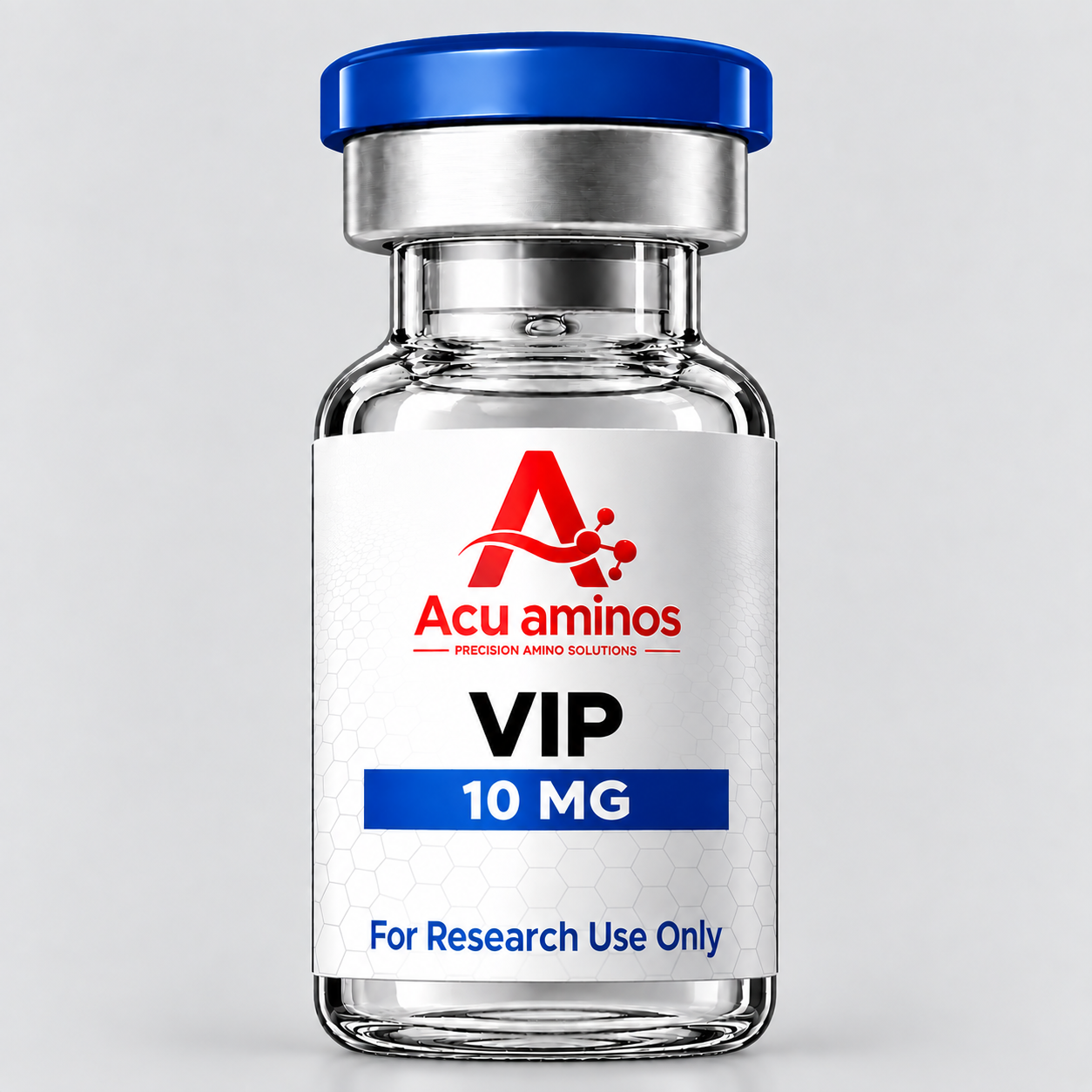
VIP 10mg
$74.99
Vasoactive intestinal peptide, a 28-residue C-amidated neuropeptide of the secretin/glucagon family, 10 mg lyophilized. Endogenous ligand of VPAC1 and VPAC2 receptors, used in neuro-immune and smooth-muscle signaling research. ≥99% purity. Research use only.
Overview
Vasoactive intestinal peptide (VIP) is a 28-amino-acid neuropeptide first isolated from porcine small intestine by Said and Mutt in 1970. It belongs to the secretin/glucagon superfamily and is broadly distributed in the central and peripheral nervous systems, the gut and immune tissues. VIP is the endogenous ligand for the VPAC1 and VPAC2 receptors and also binds the PAC1 receptor with lower affinity.
Acu Aminos supplies VIP as a 10 mg lyophilized powder for laboratory receptor and neuro-immune research.
Chemistry & specifications
VIP is a basic, C-terminally amidated peptide that is largely disordered in water and adopts an α-helical conformation from roughly residue 7 onward when bound to its receptor or in membrane-mimetic environments. The N-terminal His-Ser-Asp region is critical for receptor activation, and the single methionine residue (Met17) is susceptible to oxidation, which is why the lyophilized material should be protected from air.
| Sequence | His-Ser-Asp-Ala-Val-Phe-Thr-Asp-Asn-Tyr-Thr-Arg-Leu-Arg-Lys-Gln-Met-Ala-Val-Lys-Lys-Tyr-Leu-Asn-Ser-Ile-Leu-Asn-NH2 |
|---|---|
| Molecular formula | C147H237N43O43S |
| Molecular weight | 3326.8 g/mol |
| CAS | 37221-79-7 |
| Net content | 10 mg per vial |
| Form | Lyophilized powder |
| Purity | ≥99% (HPLC) |
| Appearance | White lyophilized powder |
| Solubility | Water soluble |
| Storage | Lyophilized: −20 °C long term, 2–8 °C short term. Protect from light and moisture. Contains methionine; minimize oxidation. |
Cellular structure & mechanism of action
VPAC1 and VPAC2 are class B GPCRs coupled primarily to Gαs, and VIP binding raises intracellular cAMP with downstream activation of PKA and CREB. In smooth-muscle preparations this pathway underlies the peptide’s classical relaxant activity. In immune-cell models, VIP signaling has been reported to shift macrophage and dendritic-cell cytokine output toward an anti-inflammatory profile, to influence T-helper differentiation and to induce regulatory T-cell phenotypes, which has made it a reference neuropeptide for neuro-immune interaction research. VIP also acts as a neurotransmitter in the suprachiasmatic nucleus, where VPAC2 signaling synchronizes circadian oscillators in tissue-slice models.
Research applications
- VPAC1/VPAC2/PAC1 receptor binding and cAMP assays
- Macrophage, dendritic-cell and T-cell cytokine studies
- Smooth-muscle relaxation and organ-bath pharmacology
- Circadian-rhythm and SCN neuron models
- Secretin-family peptide structure-activity research
Selected references
- Said SI, Mutt V. Polypeptide with broad biological activity: isolation from small intestine. Science. 1970;169:1217–1218.
- Harmar AJ, Fahrenkrug J, Gozes I, et al. Pharmacology and functions of receptors for vasoactive intestinal peptide and pituitary adenylate cyclase-activating polypeptide: IUPHAR review 1. Br J Pharmacol. 2012;166(1):4–17.
- Delgado M, Ganea D. Vasoactive intestinal peptide: a neuropeptide with pleiotropic immune functions. Amino Acids. 2013;45(1):25–39.
References are provided to help researchers locate primary literature. Acu Aminos makes no claims about the safety or efficacy of any compound in humans or animals.
What are research peptides?
Structure
Peptides are chains of amino acids joined by amide (peptide) bonds. Short chains of 2 to roughly 50 residues are called peptides; longer chains fold into proteins. Sequence, chain length and terminal modifications define how a peptide behaves.
Synthesis & purity
Research peptides are built by solid-phase peptide synthesis, cleaved from the resin, purified by reverse-phase HPLC and lyophilized to a stable powder. Purity is reported as the HPLC area percentage of the target peak; identity is confirmed by mass spectrometry.
Laboratory use
In the lab, peptides serve as receptor ligands, enzyme substrates, signaling probes and reference standards in cell-culture, biochemical and analytical studies. Our products are supplied exclusively for these in-vitro research applications.
Handling & storage
Lyophilized peptides should be kept sealed, protected from light and moisture, and stored refrigerated or frozen for long-term stability. Allow vials to reach room temperature before opening to prevent condensation.
All information on this page is provided for educational and research reference only and does not constitute medical advice or a recommendation for use in humans or animals.
Related research peptides
-
99% Purity
 Immune & Neuro Peptides
Pinealon 20mg
20 mg · Glu-Asp-Arg bioregulator tripeptide · ≥99% purity$59.99In stock -
99% Purity
 Immune & Neuro Peptides
Thymosin Alpha-1 10mg
10 mg · 28-aa acetylated thymic peptide · ≥99% purity$99.99In stock -
99% Purity
 Immune & Neuro Peptides
Kisspeptin-10 10mg
10 mg · KISS1R ligand decapeptide · ≥99% purity$49.99In stock