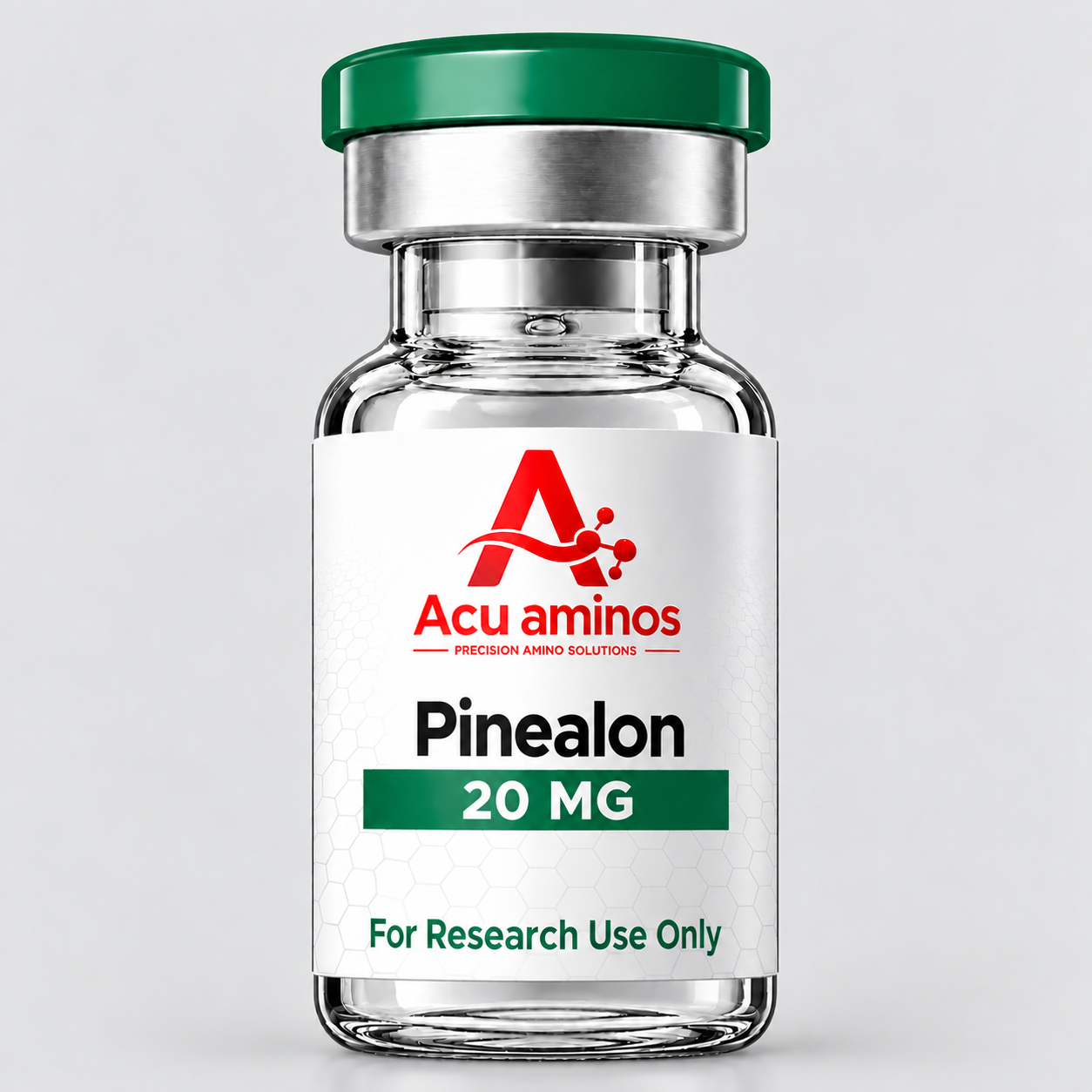
Pinealon 20mg
$59.99
Synthetic tripeptide Glu-Asp-Arg (EDR), 20 mg lyophilized. A short-chain “bioregulator” peptide studied in neuronal cell-culture, oxidative-stress and gene-expression models. ≥99% purity. Research use only.
Overview
Pinealon is the synthetic tripeptide L-glutamyl-L-aspartyl-L-arginine (EDR), one of a family of short peptides developed at the St. Petersburg Institute of Bioregulation and Gerontology. These peptides were designed to mimic the amino-acid composition of tissue-specific extracts and are studied primarily for their reported interactions with DNA and their effects on gene expression in cell culture.
Acu Aminos supplies Pinealon as a 20 mg lyophilized powder for laboratory research.
Chemistry & specifications
EDR is a highly polar, acidic tripeptide carrying two carboxylate side chains (Glu, Asp) and one guanidinium group (Arg). Molecular-modeling studies from the originating laboratory propose that this charge pattern allows the peptide to bind in the major groove of double-stranded DNA at specific promoter sequences.
| Sequence | Glu-Asp-Arg |
|---|---|
| Molecular formula | C15H26N6O8 |
| Molecular weight | 418.4 g/mol |
| Net content | 20 mg per vial |
| Form | Lyophilized powder |
| Purity | ≥99% (HPLC) |
| Appearance | White lyophilized powder |
| Solubility | Water soluble |
| Storage | Lyophilized: −20 °C long term, 2–8 °C short term. Protect from light and moisture. |
Cellular structure & mechanism of action
Published work on Pinealon and related short peptides reports cell-penetrating behavior in culture, with fluorescently labeled peptide observed in the cytoplasm and nucleus. Proposed mechanisms include modulation of the expression of neuronal differentiation markers, regulation of reactive-oxygen-species levels in cortical neuron cultures, and altered expression of proliferation- and apoptosis-related proteins. Studies in prenatal hyperhomocysteinemia rodent models have examined its effects on oxidative markers in neural tissue. These findings come largely from a single research group and are best regarded as hypothesis-generating for independent laboratories.
Research applications
- Neuronal cell-culture differentiation and viability assays
- Oxidative-stress and ROS quantification in neural cells
- Peptide–DNA interaction and promoter-binding studies
- Short-peptide gene-expression profiling
Selected references
- Khavinson VK, Linkova NS, Tarnovskaya SI. Short peptides regulate gene expression. Bull Exp Biol Med. 2016;162(2):288–292.
- Arutjunyan A, Kozina L, Stvolinskiy S, et al. Pinealon protects the rat offspring from prenatal hyperhomocysteinemia. Int J Clin Exp Med. 2012;5(2):179–185.
- Khavinson VK, Popovich IG, Linkova NS, Mironova ES, Ilina AR. Peptide regulation of gene expression: a systematic review. Molecules. 2021;26(22):7053.
References are provided to help researchers locate primary literature. Acu Aminos makes no claims about the safety or efficacy of any compound in humans or animals.
What are research peptides?
Structure
Peptides are chains of amino acids joined by amide (peptide) bonds. Short chains of 2 to roughly 50 residues are called peptides; longer chains fold into proteins. Sequence, chain length and terminal modifications define how a peptide behaves.
Synthesis & purity
Research peptides are built by solid-phase peptide synthesis, cleaved from the resin, purified by reverse-phase HPLC and lyophilized to a stable powder. Purity is reported as the HPLC area percentage of the target peak; identity is confirmed by mass spectrometry.
Laboratory use
In the lab, peptides serve as receptor ligands, enzyme substrates, signaling probes and reference standards in cell-culture, biochemical and analytical studies. Our products are supplied exclusively for these in-vitro research applications.
Handling & storage
Lyophilized peptides should be kept sealed, protected from light and moisture, and stored refrigerated or frozen for long-term stability. Allow vials to reach room temperature before opening to prevent condensation.
All information on this page is provided for educational and research reference only and does not constitute medical advice or a recommendation for use in humans or animals.
Related research peptides
-
99% Purity
 Immune & Neuro Peptides
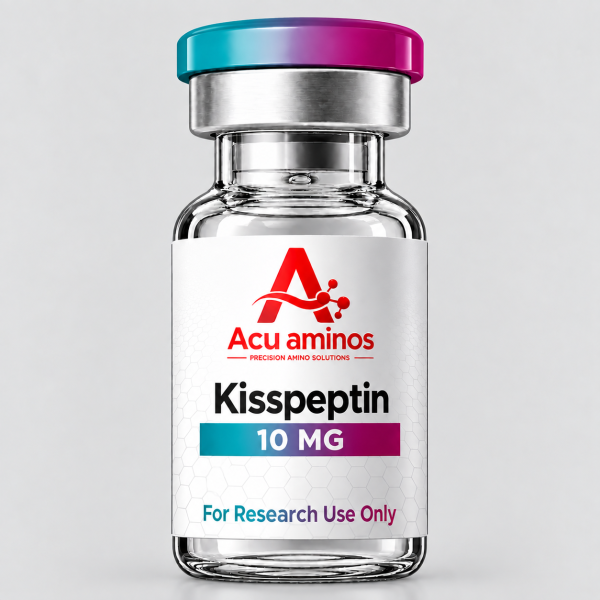
Kisspeptin-10 10mg
10 mg · KISS1R ligand decapeptide · ≥99% purity$49.99In stock -
99% Purity
 Immune & Neuro Peptides
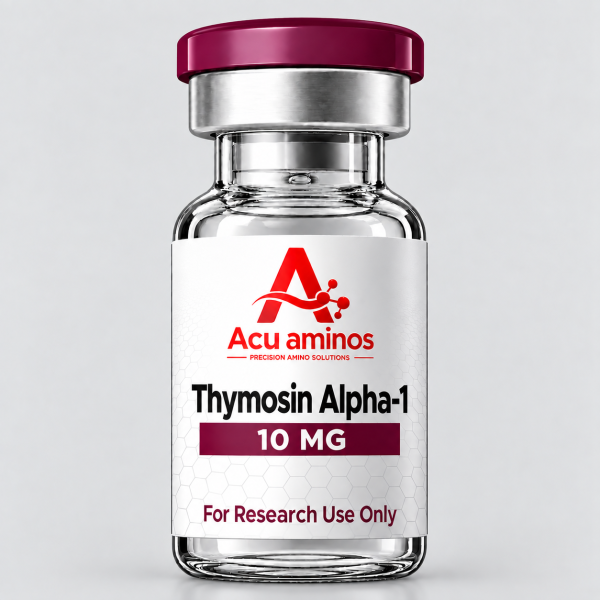
Thymosin Alpha-1 10mg
10 mg · 28-aa acetylated thymic peptide · ≥99% purity$99.99In stock