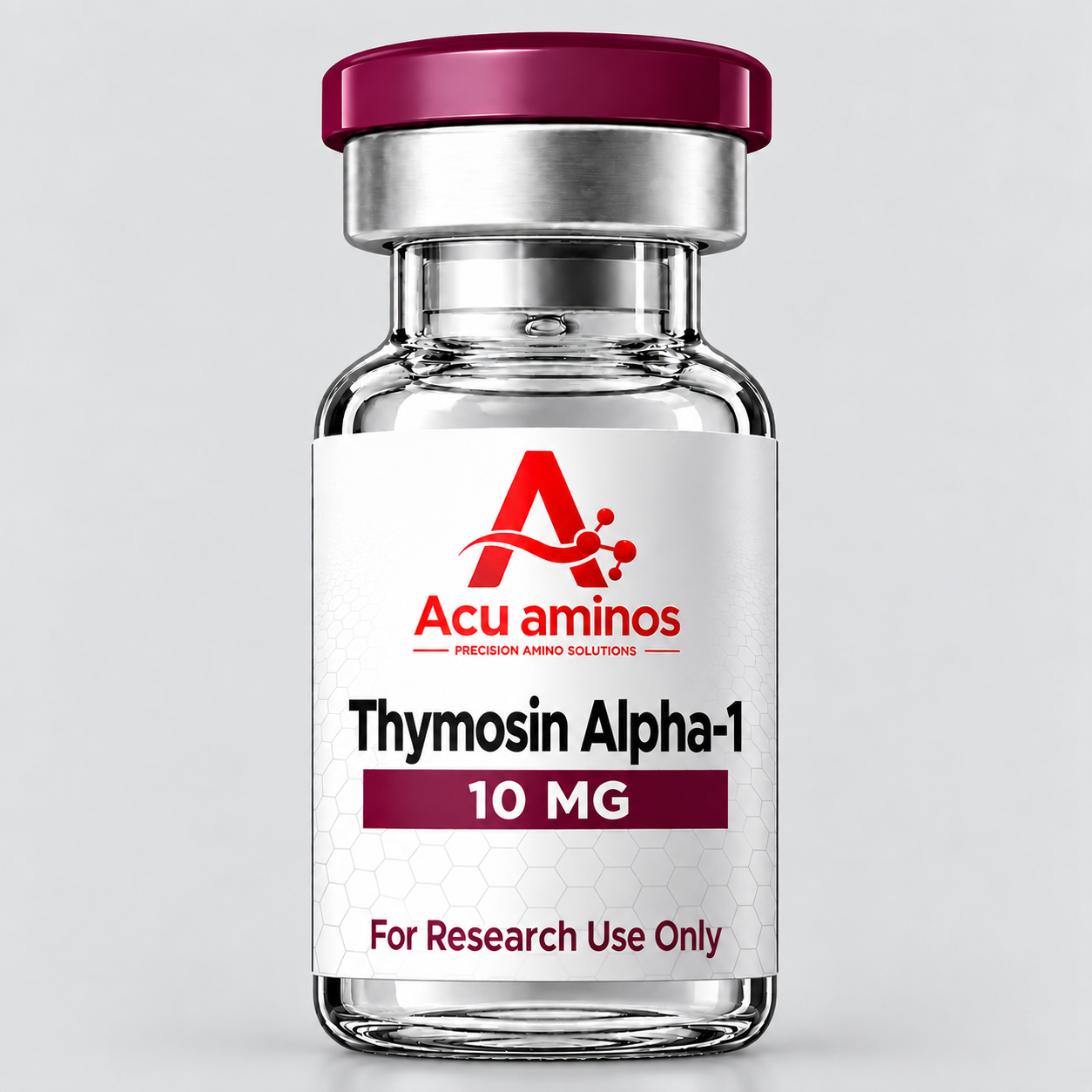
Thymosin Alpha-1 10mg
$99.99
N-acetylated 28-residue thymic peptide (Tα1), 10 mg lyophilized. Studied in dendritic-cell, Toll-like-receptor and T-cell signaling research. ≥99% purity, COA for every lot. Research use only.
Overview
Thymosin α1 (Tα1) is a 28-amino-acid, N-terminally acetylated peptide first isolated from calf thymus fraction 5 in 1977. It is derived from the N-terminal region of prothymosin α and is one of the most extensively characterized thymic peptides in immunology literature, where it is studied as a modulator of innate and adaptive immune-cell function.
Acu Aminos supplies Thymosin α1 as a 10 mg lyophilized powder for laboratory immunology research.
Chemistry & specifications
Tα1 is a highly acidic, unstructured peptide in aqueous solution, with a net negative charge from its numerous Asp and Glu residues. The N-terminal acetyl group is a post-translational feature of the native peptide and is retained in the synthetic material. Circular-dichroism studies show a transition to partial helical structure in membrane-mimetic environments.
| Sequence | Ac-Ser-Asp-Ala-Ala-Val-Asp-Thr-Ser-Ser-Glu-Ile-Thr-Thr-Lys-Asp-Leu-Lys-Glu-Lys-Lys-Glu-Val-Val-Glu-Glu-Ala-Glu-Asn-OH |
|---|---|
| Molecular formula | C129H215N33O55 |
| Molecular weight | 3108.3 g/mol |
| CAS | 62304-98-7 |
| Net content | 10 mg per vial |
| Form | Lyophilized powder |
| Purity | ≥99% (HPLC) |
| Appearance | White lyophilized powder |
| Solubility | Water soluble |
| Storage | Lyophilized: −20 °C long term, 2–8 °C short term. Protect from light and moisture. |
Cellular structure & mechanism of action
In vitro and animal studies report that Tα1 acts through Toll-like receptors, particularly TLR2 and TLR9, on dendritic cells and other antigen-presenting cells, promoting MyD88-dependent signaling and the maturation of dendritic cells. Downstream effects described in the literature include increased expression of MHC class I molecules, modulation of cytokine profiles (IL-2, IFN-γ, IL-12), enhanced natural-killer-cell activity and changes in the balance of regulatory and effector T-cell responses. It has also been studied for effects on intracellular glutathione and oxidative stress in immune cells.
Research applications
- Dendritic-cell maturation and TLR-signaling assays
- T-cell differentiation and cytokine-profiling studies
- NK-cell cytotoxicity and innate-immunity models
- Thymic-peptide structure-function research
Selected references
- Goldstein AL, Low TL, McAdoo M, et al. Thymosin α1: isolation and sequence analysis of an immunologically active thymic polypeptide. Proc Natl Acad Sci USA. 1977;74(2):725–729.
- Romani L, Bistoni F, Montagnoli C, et al. Thymosin α1: an endogenous regulator of inflammation, immunity, and tolerance. Ann N Y Acad Sci. 2007;1112:326–338.
- Dominari A, Hathaway III D, Pandav K, et al. Thymosin alpha 1: a comprehensive review of the literature. World J Virol. 2020;9(5):67–78.
References are provided to help researchers locate primary literature. Acu Aminos makes no claims about the safety or efficacy of any compound in humans or animals.
What are research peptides?
Structure
Peptides are chains of amino acids joined by amide (peptide) bonds. Short chains of 2 to roughly 50 residues are called peptides; longer chains fold into proteins. Sequence, chain length and terminal modifications define how a peptide behaves.
Synthesis & purity
Research peptides are built by solid-phase peptide synthesis, cleaved from the resin, purified by reverse-phase HPLC and lyophilized to a stable powder. Purity is reported as the HPLC area percentage of the target peak; identity is confirmed by mass spectrometry.
Laboratory use
In the lab, peptides serve as receptor ligands, enzyme substrates, signaling probes and reference standards in cell-culture, biochemical and analytical studies. Our products are supplied exclusively for these in-vitro research applications.
Handling & storage
Lyophilized peptides should be kept sealed, protected from light and moisture, and stored refrigerated or frozen for long-term stability. Allow vials to reach room temperature before opening to prevent condensation.
All information on this page is provided for educational and research reference only and does not constitute medical advice or a recommendation for use in humans or animals.
Related research peptides
-
99% Purity
 Immune & Neuro Peptides
Pinealon 20mg
20 mg · Glu-Asp-Arg bioregulator tripeptide · ≥99% purity$59.99In stock -
99% Purity
 Immune & Neuro Peptides
Kisspeptin-10 10mg
10 mg · KISS1R ligand decapeptide · ≥99% purity$49.99In stock -
99% Purity
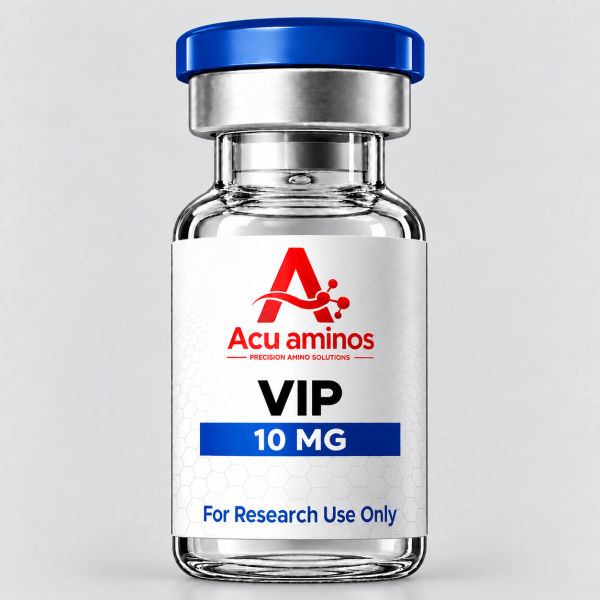 Immune & Neuro Peptides
VIP 10mg
10 mg · Vasoactive intestinal peptide, 28 aa · ≥99% purity$74.99In stock