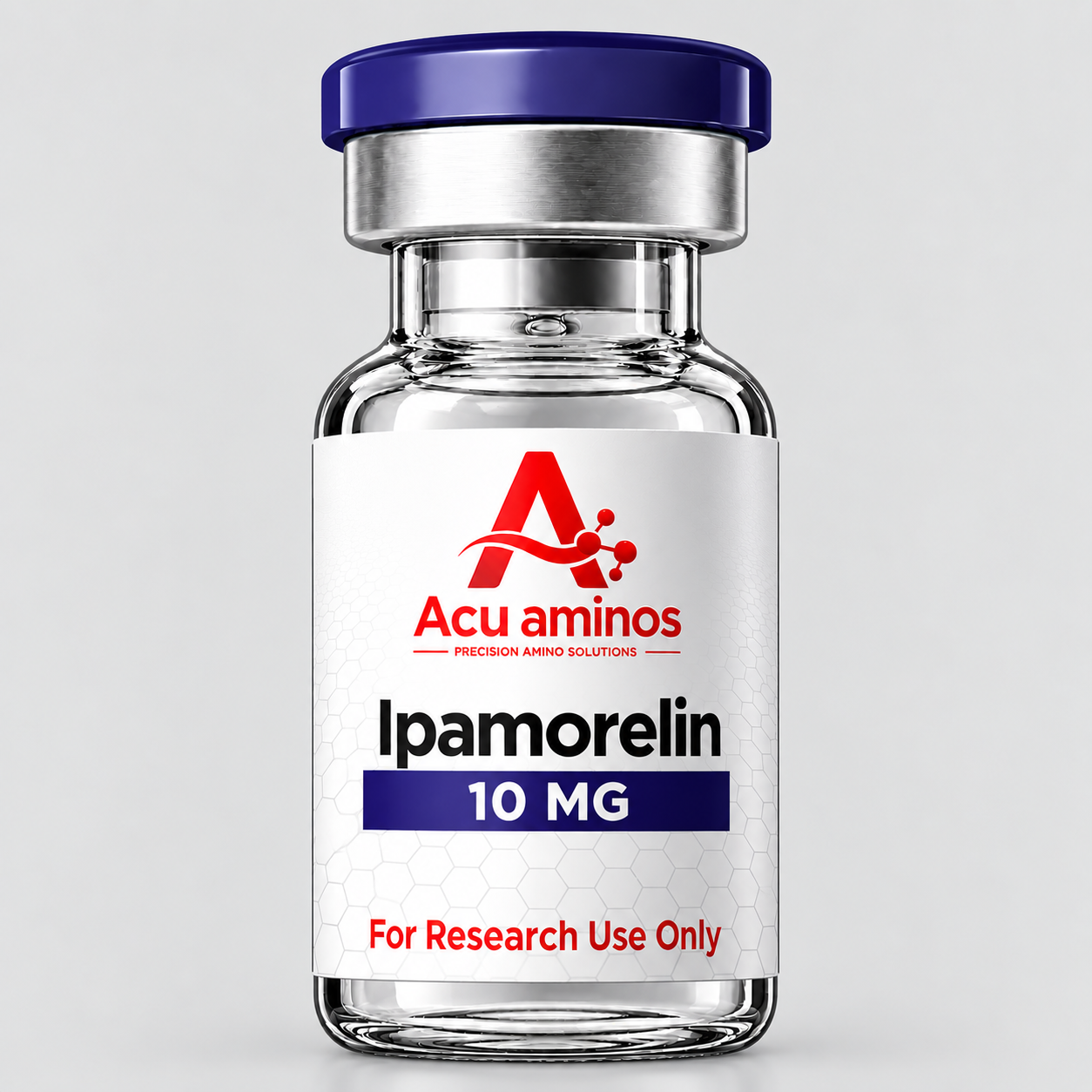
Ipamorelin 10mg
$54.99
Synthetic pentapeptide (Aib-His-D-2-Nal-D-Phe-Lys-NH₂), 10 mg lyophilized. A selective agonist of the growth hormone secretagogue receptor (GHS-R1a) used in receptor-pharmacology and endocrine-signaling research. ≥99% purity. Research use only.
Overview
Ipamorelin is a synthetic pentapeptide developed by Novo Nordisk in the 1990s as a growth hormone secretagogue. It was the first compound in its class reported to release growth hormone in animal models with high selectivity, without the concomitant ACTH and cortisol release seen with earlier GHRP compounds. It acts as an agonist at the ghrelin receptor (GHS-R1a).
Acu Aminos supplies Ipamorelin as a 10 mg lyophilized powder for receptor-binding, signaling and endocrine-cell research.
Chemistry & specifications
Ipamorelin contains two non-natural residues, α-aminoisobutyric acid (Aib) at the N-terminus and D-2-naphthylalanine, plus a D-phenylalanine, all of which confer resistance to proteolysis. The C-terminus is amidated. The aromatic D-2-Nal and D-Phe side chains are considered essential for receptor binding, mirroring the pharmacophore of the earlier GHRP series.
| Sequence | Aib-His-D-2-Nal-D-Phe-Lys-NH2 |
|---|---|
| Molecular formula | C38H49N9O5 |
| Molecular weight | 711.9 g/mol |
| CAS | 170851-70-4 |
| Net content | 10 mg per vial |
| Form | Lyophilized powder |
| Purity | ≥99% (HPLC) |
| Appearance | White lyophilized powder |
| Solubility | Water soluble |
| Storage | Lyophilized: −20 °C long term, 2–8 °C short term. Protect from light and moisture. |
Cellular structure & mechanism of action
GHS-R1a is a G-protein-coupled receptor expressed in the pituitary and hypothalamus, as well as in peripheral tissues. Agonist binding activates Gαq/11, stimulating phospholipase C, inositol-trisphosphate production and an increase in intracellular calcium in somatotroph cells. In the original characterization, Ipamorelin displayed a potency comparable to GHRP-6 in rat pituitary cell assays while showing markedly less effect on ACTH, cortisol and prolactin, which is why it is often used as a selective reference agonist in GHS-R pharmacology.
Research applications
- GHS-R1a receptor binding and functional (calcium-flux) assays
- Somatotroph cell signaling and secretion models in vitro
- Ghrelin-receptor structure-activity relationship studies
- Comparative secretagogue selectivity research
Selected references
- Raun K, Hansen BS, Johansen NL, et al. Ipamorelin, the first selective growth hormone secretagogue. Eur J Endocrinol. 1998;139(5):552–561.
- Johansen PB, Nowak J, Skjaerbaek C, et al. Ipamorelin, a new growth-hormone-releasing peptide, induces longitudinal bone growth in rats. Growth Horm IGF Res. 1999;9(2):106–113.
- Kojima M, Hosoda H, Date Y, et al. Ghrelin is a growth-hormone-releasing acylated peptide from stomach. Nature. 1999;402:656–660.
References are provided to help researchers locate primary literature. Acu Aminos makes no claims about the safety or efficacy of any compound in humans or animals.
What are research peptides?
Structure
Peptides are chains of amino acids joined by amide (peptide) bonds. Short chains of 2 to roughly 50 residues are called peptides; longer chains fold into proteins. Sequence, chain length and terminal modifications define how a peptide behaves.
Synthesis & purity
Research peptides are built by solid-phase peptide synthesis, cleaved from the resin, purified by reverse-phase HPLC and lyophilized to a stable powder. Purity is reported as the HPLC area percentage of the target peak; identity is confirmed by mass spectrometry.
Laboratory use
In the lab, peptides serve as receptor ligands, enzyme substrates, signaling probes and reference standards in cell-culture, biochemical and analytical studies. Our products are supplied exclusively for these in-vitro research applications.
Handling & storage
Lyophilized peptides should be kept sealed, protected from light and moisture, and stored refrigerated or frozen for long-term stability. Allow vials to reach room temperature before opening to prevent condensation.
All information on this page is provided for educational and research reference only and does not constitute medical advice or a recommendation for use in humans or animals.
Related research peptides
-
99% Purity
 Metabolic & Incretin Peptides
Retatrutide
15 mg or 40 mg · GIP/GLP-1/glucagon triple agonist · ≥99% purityFrom $109.99In stockChoose size This product has multiple variants. The options may be chosen on the product page -
99% Purity
 Immune & Neuro Peptides
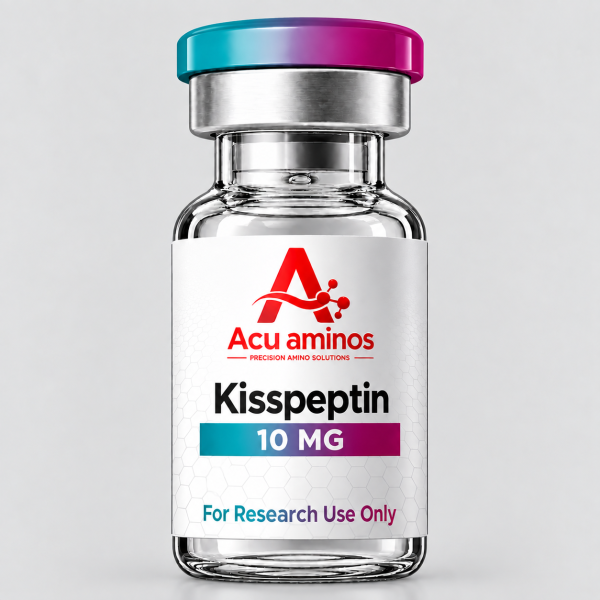
Kisspeptin-10 10mg
10 mg · KISS1R ligand decapeptide · ≥99% purity$49.99In stock -
99% Purity
 Growth Hormone Secretagogues
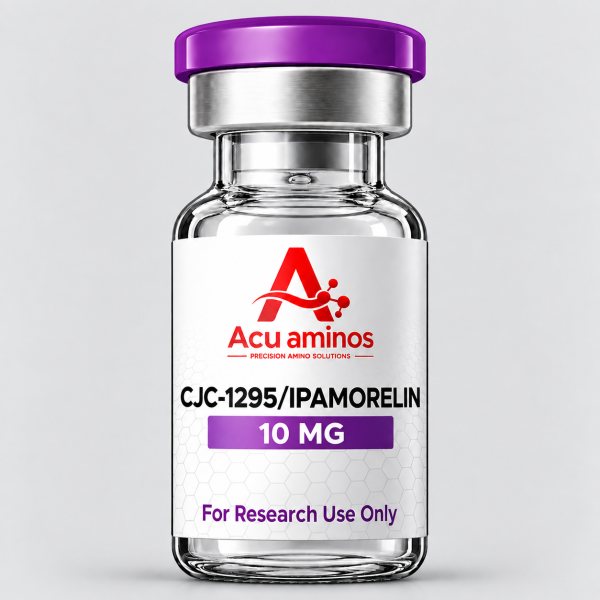
CJC-1295 / Ipamorelin 10mg
10 mg · CJC-1295 (no DAC) 5 mg + Ipamorelin 5 mg · ≥99% purity$84.99In stock