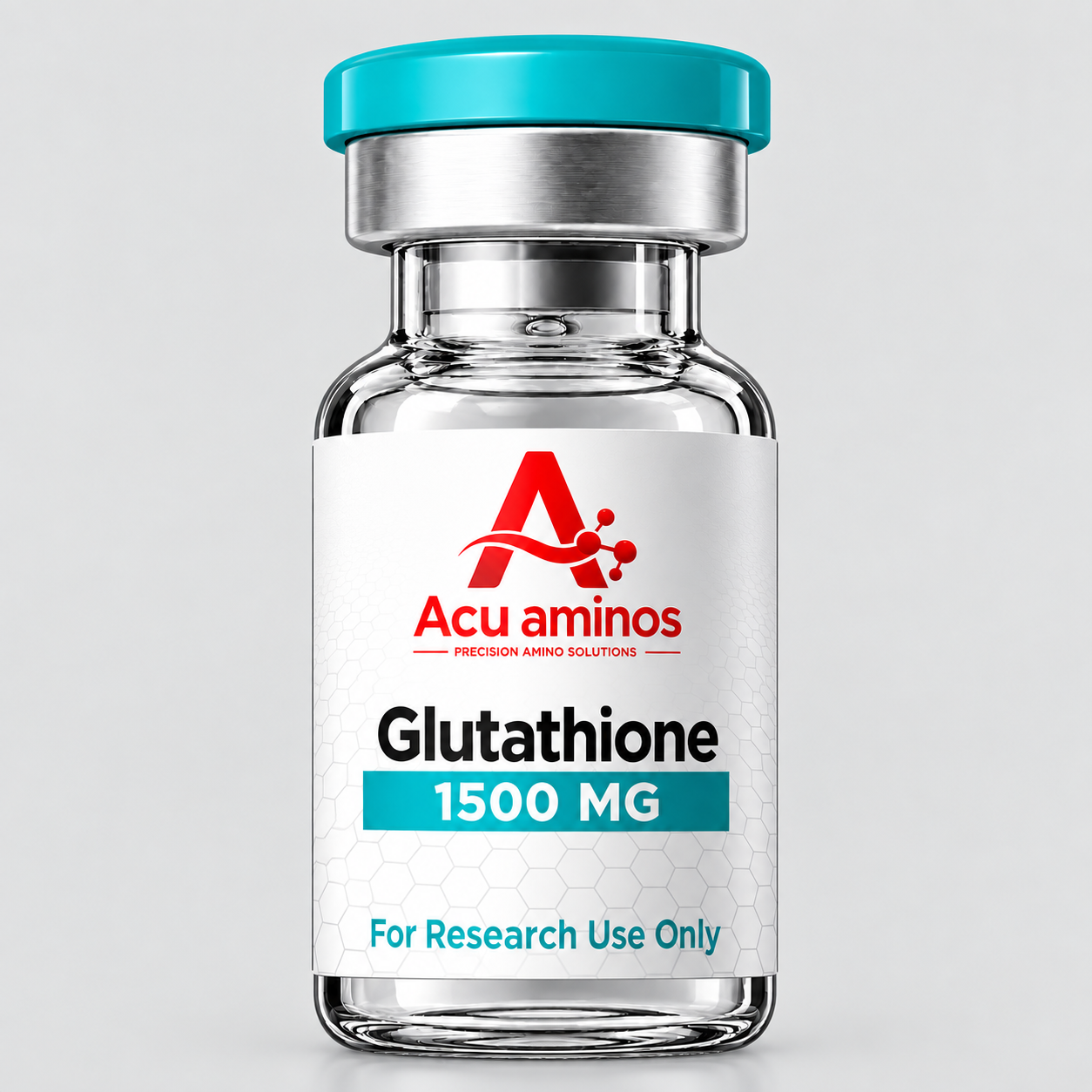
Glutathione 1500mg
$69.99
Reduced L-glutathione (γ-L-glutamyl-L-cysteinyl-glycine), 1500 mg lyophilized. The principal low-molecular-weight thiol in mammalian cells, used as a reference compound in redox, detoxification and oxidative-stress research. ≥99% purity. Research use only.
Overview
Glutathione (GSH) is a tripeptide composed of glutamate, cysteine and glycine, and is the most abundant non-protein thiol in mammalian cells, typically present at millimolar concentrations. The unusual γ-peptide bond between glutamate and cysteine makes GSH resistant to most peptidases. Its reduced (GSH) and oxidized (GSSG) forms constitute the cell’s principal redox buffer.
Acu Aminos supplies reduced glutathione as a 1500 mg lyophilized powder for laboratory redox, enzymology and cell-culture research.
Chemistry & specifications
GSH is synthesized in two ATP-dependent steps: glutamate-cysteine ligase forms γ-glutamylcysteine, and glutathione synthetase adds glycine. The free thiol of the cysteine residue is the reactive center, serving as a nucleophile in conjugation reactions and as an electron donor for glutathione peroxidases. Two GSH molecules oxidize to glutathione disulfide (GSSG), which is recycled by NADPH-dependent glutathione reductase.
| Sequence | γ-Glu-Cys-Gly |
|---|---|
| Molecular formula | C10H17N3O6S |
| Molecular weight | 307.32 g/mol |
| CAS | 70-18-8 |
| Net content | 1500 mg per vial |
| Form | Lyophilized powder |
| Purity | ≥99% (HPLC) |
| Appearance | White crystalline powder |
| Solubility | Water soluble |
| Storage | Lyophilized: −20 °C long term, 2–8 °C short term. Protect from light and moisture. Thiol is oxidation-sensitive; minimize air exposure. |
Cellular structure & mechanism of action
Inside the cell, GSH participates in three broad classes of reactions: direct scavenging of reactive oxygen and nitrogen species, enzymatic reduction of peroxides via glutathione peroxidases, and conjugation of electrophiles by glutathione S-transferases for export and excretion. Protein S-glutathionylation, the reversible attachment of GSH to protein cysteines, is a recognized redox-signaling mechanism that modulates enzyme activity and transcription-factor function.
The GSH/GSSG ratio is widely used as an experimental readout of cellular oxidative stress, and exogenous GSH is a common positive control in antioxidant-capacity and cytoprotection assays.
Research applications
- Cellular redox-state and GSH/GSSG ratio assays
- Glutathione peroxidase, reductase and S-transferase enzymology
- Xenobiotic conjugation and detoxification pathway studies
- Oxidative-stress and cytoprotection cell-culture models
- Analytical reference standard for HPLC and LC-MS methods
Selected references
- Meister A, Anderson ME. Glutathione. Annu Rev Biochem. 1983;52:711–760.
- Wu G, Fang YZ, Yang S, Lupton JR, Turner ND. Glutathione metabolism and its implications for health. J Nutr. 2004;134(3):489–492.
- Forman HJ, Zhang H, Rinna A. Glutathione: overview of its protective roles, measurement, and biosynthesis. Mol Aspects Med. 2009;30(1–2):1–12.
References are provided to help researchers locate primary literature. Acu Aminos makes no claims about the safety or efficacy of any compound in humans or animals.
What are research peptides?
Structure
Peptides are chains of amino acids joined by amide (peptide) bonds. Short chains of 2 to roughly 50 residues are called peptides; longer chains fold into proteins. Sequence, chain length and terminal modifications define how a peptide behaves.
Synthesis & purity
Research peptides are built by solid-phase peptide synthesis, cleaved from the resin, purified by reverse-phase HPLC and lyophilized to a stable powder. Purity is reported as the HPLC area percentage of the target peak; identity is confirmed by mass spectrometry.
Laboratory use
In the lab, peptides serve as receptor ligands, enzyme substrates, signaling probes and reference standards in cell-culture, biochemical and analytical studies. Our products are supplied exclusively for these in-vitro research applications.
Handling & storage
Lyophilized peptides should be kept sealed, protected from light and moisture, and stored refrigerated or frozen for long-term stability. Allow vials to reach room temperature before opening to prevent condensation.
All information on this page is provided for educational and research reference only and does not constitute medical advice or a recommendation for use in humans or animals.
Related research peptides
-
99% Purity
 Immune & Neuro Peptides
Pinealon 20mg
20 mg · Glu-Asp-Arg bioregulator tripeptide · ≥99% purity$59.99In stock -
99% Purity
 Immune & Neuro Peptides
VIP 10mg
10 mg · Vasoactive intestinal peptide, 28 aa · ≥99% purity$74.99In stock