
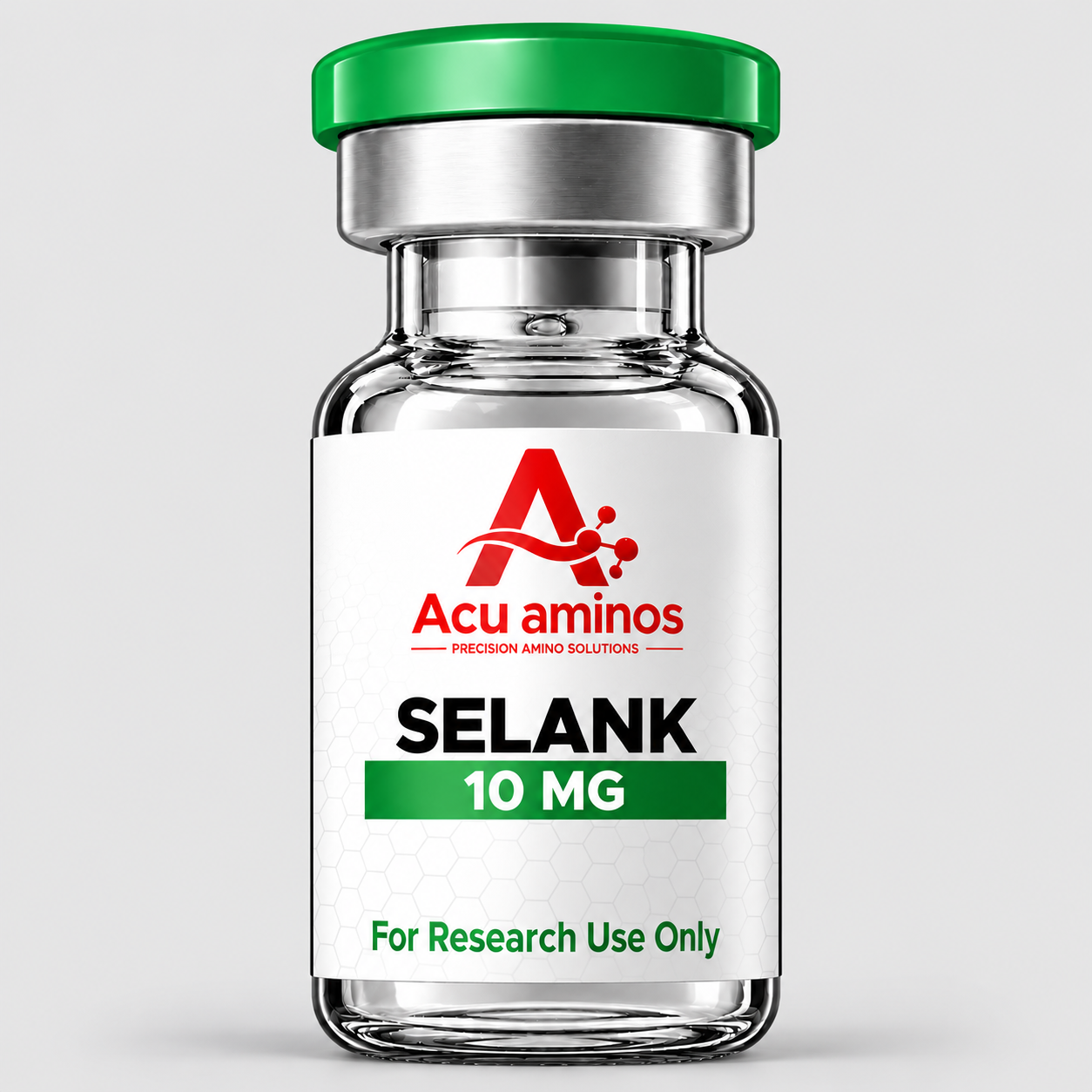
Selank 10mg
$54.99
Synthetic heptapeptide Thr-Lys-Pro-Arg-Pro-Gly-Pro, 10 mg lyophilized. ≥99% purity by HPLC, COA published online. Research use only.
Overview
Selank is a synthetic seven-residue peptide. Its first four residues (Thr-Lys-Pro-Arg) correspond to the tetrapeptide tuftsin, extended at the C-terminus with the tripeptide Pro-Gly-Pro. It was developed at the Institute of Molecular Genetics of the Russian Academy of Sciences.
Acu Aminos supplies Selank as a 10 mg lyophilized powder with HPLC purity and mass-spectrometry identity on the Certificate of Analysis.
Chemistry & specifications
Sequence: Thr-Lys-Pro-Arg-Pro-Gly-Pro. Two basic residues (lysine, arginine) give the peptide a net positive charge at neutral pH; the proline-rich C-terminal segment improves stability in aqueous solution. Freely water soluble.
| Sequence | Thr-Lys-Pro-Arg-Pro-Gly-Pro |
|---|---|
| Molecular formula | C33H57N11O9 |
| Molecular mass | 751.9 g/mol |
| CAS | 129954-34-3 |
| Net content | 10 mg per vial |
| Form | Lyophilized powder |
| Purity | ≥99% (HPLC) |
| Appearance | White lyophilized powder |
| Solubility | Water soluble |
| Storage | Lyophilized: −20 °C long term, 2–8 °C short term. Protect from light and moisture. |
Quality & documentation
Every vial is produced by solid-phase peptide synthesis, purified by reverse-phase HPLC to a minimum of 99%, and identity-confirmed by mass spectrometry. The Certificate of Analysis for this product is published in our COA library and can be opened from the COA button above.
Laboratory handling & storage
Store the sealed vial at −20 °C for long-term storage or 2 to 8 °C for short-term use, protected from light and moisture. Allow the vial to reach room temperature before opening to prevent condensation. Lyophilized material is stable at ambient temperature for the duration of shipping. Handle with standard laboratory PPE and dispose of according to your institution’s chemical waste procedures.
What are research peptides?
Structure
Peptides are chains of amino acids joined by amide (peptide) bonds. Short chains of 2 to roughly 50 residues are called peptides; longer chains fold into proteins. Sequence, chain length and terminal modifications define how a peptide behaves.
Synthesis & purity
Research peptides are built by solid-phase peptide synthesis, cleaved from the resin, purified by reverse-phase HPLC and lyophilized to a stable powder. Purity is reported as the HPLC area percentage of the target peak; identity is confirmed by mass spectrometry.
Laboratory use
In the lab, peptides serve as receptor ligands, enzyme substrates, signaling probes and reference standards in cell-culture, biochemical and analytical studies. Our products are supplied exclusively for these in-vitro research applications.
Handling & storage
Lyophilized peptides should be kept sealed, protected from light and moisture, and stored refrigerated or frozen for long-term stability. Allow vials to reach room temperature before opening to prevent condensation.
All information on this page is provided for educational and research reference only and does not constitute medical advice or a recommendation for use in humans or animals.